


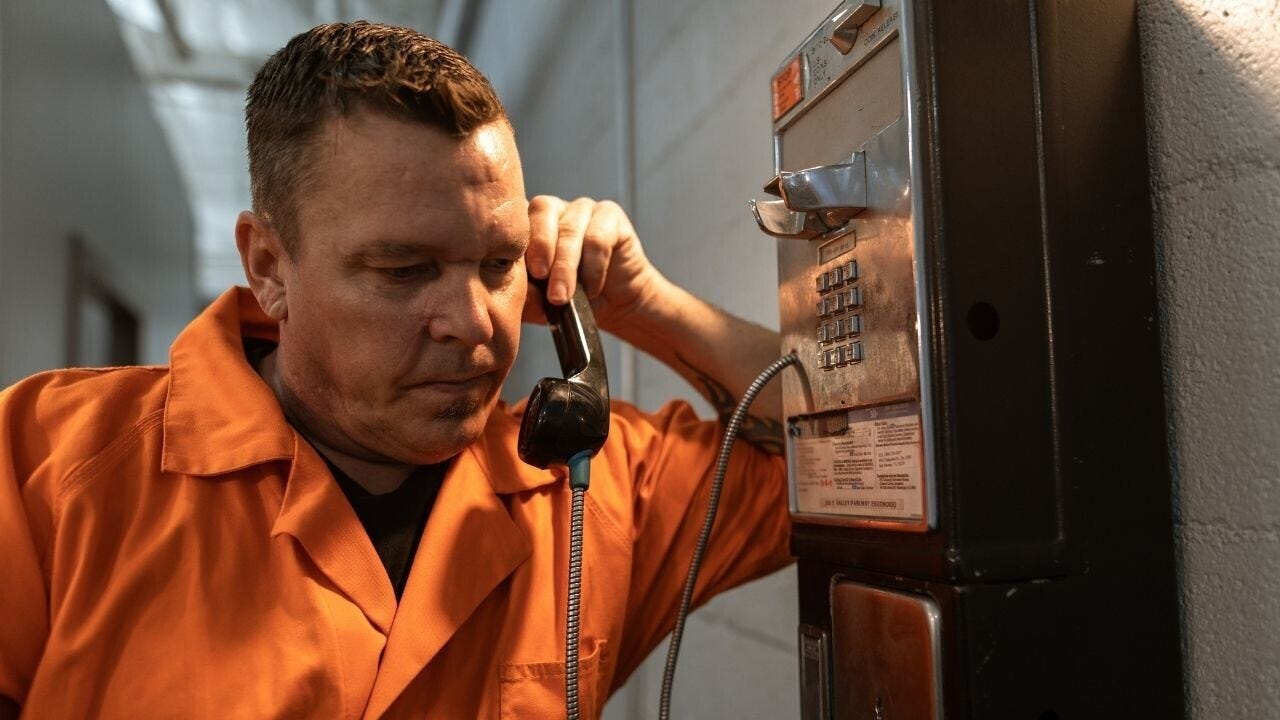
Oklahoma inmates were dialing hundreds of political calls a day, pushing messages about “creepy” people around children and warnings about transgender ideology, all funded by a Virginia super PAC that paid nearly $600,000 to the company running the calls. The inmates got $2 an hour. Some of them didn’t even know what MAGA meant.
Oklahoma prison inmates have been working in call centers placing political calls and insurance telemarketing calls on behalf of outside companies, earning $2 an hour while a Virginia-based super PAC paid nearly $600,000 to the vendor for calls supporting conservative candidates during Oklahoma’s primary election season.
What the Inmates Actually Described
Steve Wilbanks, incarcerated at James Crabtree Correctional Center in Helena, spoke to reporters about six weeks after he stopped working in the call center. “I had good numbers,” he said. “I was a producer.”
Contracts obtained through an open records request confirm a company called HBW Leads partnered with the Oklahoma Department of Corrections to establish call centers at four state prisons since January: James Crabtree in Helena, Mabel Bassett in McLoud, Lexington Correctional in Lexington, and Joseph Harp, also in Lexington. The contracts explicitly authorize “telemarketing and political polling activity.” HBW Leads pays the Department of Corrections $10 per inmate hour worked. The inmates themselves get $2 of that, plus occasional bonuses for generating leads. The remaining $8 goes to Oklahoma Correctional Industries as overhead.
Three of the four inmates interviewed requested anonymity, fearing retribution. One put it bluntly: “They definitely know what they’re doing is a no-no.”
These Weren’t Polls. Inmates Say They Were Campaign Ads.
One inmate described calls that resembled push-polling, where the caller pretends to be conducting a neutral survey but is actually trying to steer the listener’s vote, a tactic polling and marketing organizations have widely condemned.
Wilbanks said the calls carried disclosures naming Make Liberty Win, a Virginia-based super PAC focused on electing conservative lawmakers, as the funder. “They weren’t surveys at all, they were campaigning,” he said. “They just had one question at the end of the call: ‘Do we have your vote for such and such?’”
Multiple inmates said they felt uneasy delivering explicitly partisan messaging. Some had been incarcerated long enough that they didn’t recognize political terminology at all. One wasn’t sure what MAGA or a “Trump Republican” even meant. “We were talking about the swamp and everything like that,” Wilbanks said. “I don’t even know what a swamp is. I’ve been in prison too long to catch up on some of these terms.”
The Department of Corrections declined multiple interview requests. In a written statement, an agency spokesperson said the calls described by inmates, including direct candidate advocacy, still fall within the contract’s definition of “political polling,” and said the agency regularly reviews call center materials for compliance with its own policies.
The Money Trail Leads to a Trump-Endorsed Candidate’s Rival’s Loss
HBW Leads, originally founded in Oregon, was acquired in 2020 by Toledo-based Double A Solutions. In January 2025, the company launched a subsidiary called Visible Trends, specifically built for live political campaign calling, sharing the same Ohio office address as its parent.
Federal Election Commission records show Make Liberty Win has paid Visible Trends almost $600,000 since March for political calling services, primarily for state legislative races. Some of that money also went toward calls supporting Rep. Thomas Massie of Kentucky, who lost his own primary in May, despite the super PAC’s stated mission to “go directly to the voters’ doorsteps, cellphones, and mailboxes to mobilize them to oust RINOs and socialist Democrats alike.”
Barrett Young, Make Liberty Win’s executive director, said the organization had no idea Visible Trends was using prison labor, and said the super PAC has since terminated the contract, citing poor performance. Its final payment to Visible Trends was dated June 29.
Without being prompted, inmates rattled off the names of Oklahoma candidates they’d made calls for: Gentner Drummond, Mike Mazzei, Jon Echols, Chip Keating, and Justin “J.J.” Humphrey. “I only did a few Drummond, and a few J.J. Humphrey,” one inmate said. “Mostly it was Mazzei, because he was Trump-endorsed, I guess.”
None of those candidates, and no outside group, reported paying Visible Trends for this work to the Oklahoma Ethics Commission, though separate reporting has found some political organizations skirting the state’s disclosure requirements entirely.
800 Calls a Day, and a Quota to Hit
Wilbanks described the James Crabtree center as fairly standard as far as call centers go: roughly 120 cubicles, computers, dialing systems. Shifts ran from 8 a.m. to 5 p.m., later extended to 8 a.m. to 6 p.m. Inmates made as many as 800 calls a day, with roughly 500 connecting and maybe 20 of those getting passed along to a waiting insurance agent.
On insurance calls, inmates could see the customer’s name, address, phone number, and current insurer on screen, and stood to earn a $2 bonus for getting a customer’s birthday and email address too. On political calls, they could see only names and phone numbers. Inmates said they could face penalties for missing quotas.
When a reporter reached Visible Trends to ask about the inmates’ claims, a representative said “no comment” and hung up. HBW Leads didn’t respond to messages seeking comment at all.
Wilbanks eventually left the job, saying it became monotonous, but some of what he was asked to say stuck with him. “It was stuff like you don’t want to have your kids around creepy such and such, or they believe in transgender ideas not protecting your children,” he said. “It’s like, whoa. That threw me for a loop there.”
Not every inmate framed the work negatively. One said they didn’t feel coerced into taking the job at all: “It’s just better money. It’s the best money on the yard,” a comment that underscores just how limited the economic alternatives are behind bars, where $2 an hour genuinely counts as the top-paying option available.
The Bottom Line
A conservative super PAC spent close to $600,000 funneling political messaging through a company that quietly used Oklahoma prison labor to deliver it, paying incarcerated people $2 an hour to advocate for candidates some of them had never heard of, using talking points about “creepy” people and transgender ideology that unsettled even the inmates reciting them. No campaign has disclosed paying for this work. The Department of Corrections says it’s all within the rules. And this isn’t even the first time an Oklahoma prison call center scandal has made headlines; it’s just the latest one.