

Why Taxation Isn't Theft
Where bad philosophy meets atrocious economics...

"Taxation is Theft” is an unequivocally flawed statement based on a misunderstanding of the origin of ethics, the nature of social systems, and the theoretical basis of property.
I. FUNDAMENTALS
To start, let's briefly provide answers to some underlying questions necessary for us to make sense of the statement "Taxation is Theft.”
First, who are we, and what do we want as beings—a tricky question, no doubt, but a necessary prerequisite to having any coherent philosophical outlook. General consensus states that we are biological creatures produced out of a long process of evolutionary emergence and adaption. Like all creatures, we are born with an inherent strive towards experiencing satisfaction and an inherent aversion to suffering.
This doesn't mean that we always choose what will produce the most flourishing. More often than not, we don't. Sometimes this is because we are misidentifying what were really want. We often identify certain things we associate with flourishing, such as wealth, and pursue them even if our pursuit of them does not yield us the most flourishing possible. Sometimes we do pursue a flourishing existence but woefully miscalculate how we can get it and fall into addiction or hurt others in poorly thought-out acts of selfishness that deprive us of the feelings of social favorability and acceptance that are so necessary for us to be well.
Some other times we may not act with any approximation of flourishing at all but simply based on evolutionary instincts, such as when we thoughtlessly risk our lives to save a helpless child. Regardless, it seems reasonable that a generally applicable standard of what we each want is to live a flourishing existence, whether we always act in accordance with that innate motivation or not.
Ethics is a process by which we try to reconcile our internal drive for well-being with the pursuits of others. To an extent, this is made easier by the fact that for most of us, an element of our well-being is the flourishing of others. In some proportion, we suffer when others do, although this attribute varies based on the person. Additionally, the existence of many shared metrics of well-being, like life expectancy, safety, financial security, prosperity, feelings of acceptance, etc., makes moral calculations doable. Since we live among and frequently interact with others, it makes sense for us to develop rules. Rules can suit our purpose of living a flourishing existence. All systems throughout history are the products of rules.
Not all rules are the same, though. Some rules are laws and are enforced by a defined structure of decision-making with the power of enforcement. Other rules take the form of social norms that have no structured decision or enforcement mechanism but rather are enforced and adapted by each individual. These norms are often routed in popular principles, evolutionary instincts, and positive/negative associations. Collections of rules come together to produce larger systems.
When we are thinking about which system we ought to support, we have to think about how likely they are to bring about the outcome we desire. Out of the choices of rule-making mechanisms, the choice most likely to bring about our desired outcome is clear.
Chaos
Chaotic systems or, more accurately, non-systems, i.e., social environments in which no rules exist, are likely to produce undesirable outcomes. If each of us is pursuing, even rationally, our own approximations of what will produce flourishing without any rules or even reasonable expectation of the common acquiescence to certain common norms, it is very likely that most, if not all of us, will be worse off.

Anarchy
Anarchistic systems, if possible (which many think is unlikely ), consist solely of norms. They have rules, but not rules that any decision-making process produced. Rather each person may accept certain conceptions of what is permitted and not permitted based on some underlying principle. The issues of these types of systems are manyfold, but principle among them is the collective action problem (see prisoners dilemma).
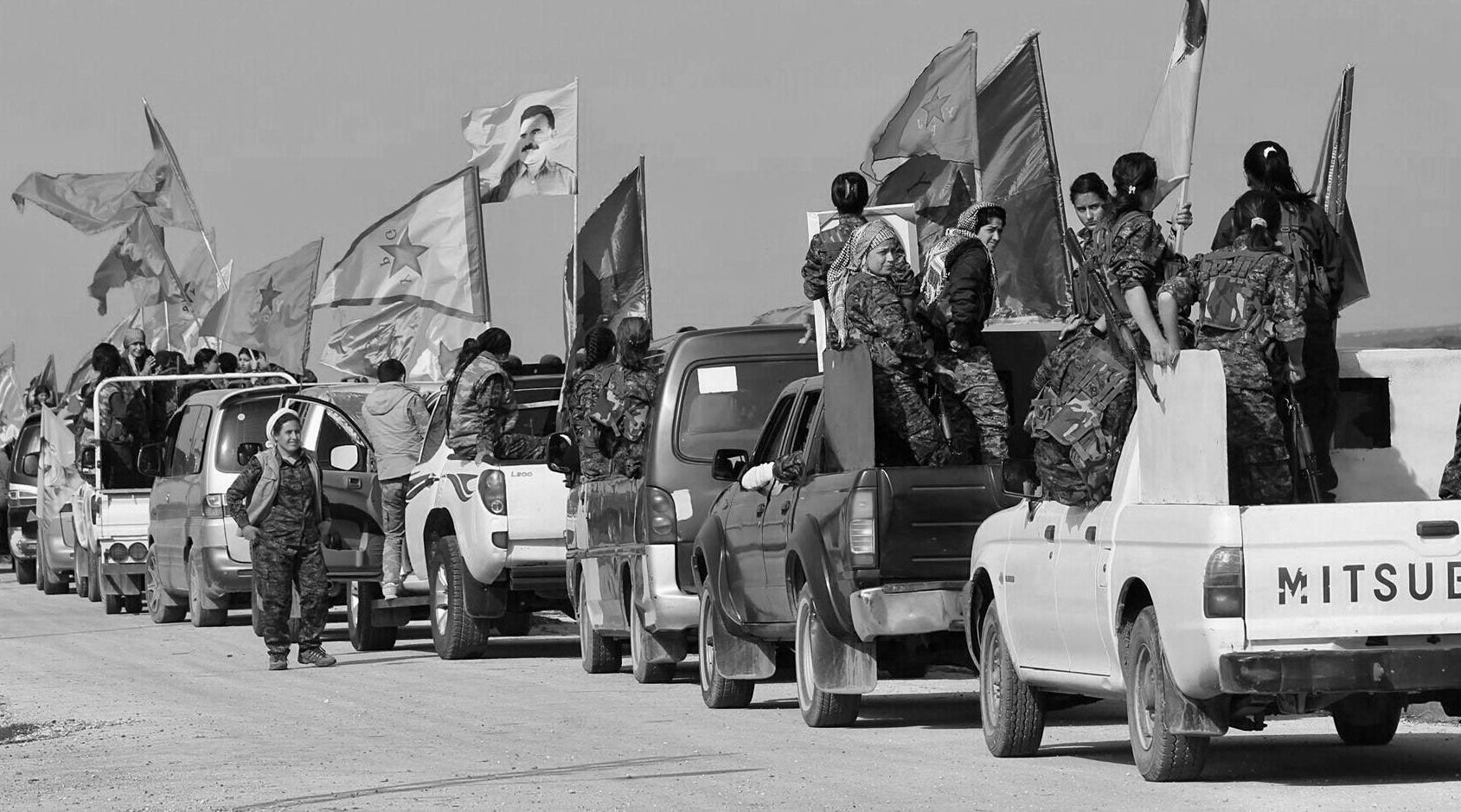
It may very well be rational for us to abide by general social norms, but when there is no venue for us to able to change them, similar to chaotic systems, we can all be worse off. A bunch of fishermen may generally abide by a principle of non-aggression and private property rights, allowing some existence of widespread organized fishing to exist, but can still plunge themselves into starvation if they fish their water source into lifelessness. This is all assuming the previous state of social rulemaking is even possible, which we have seen over and over not to be the case.
Rather when a power vacuum arises, more often than not, a new oligarchic process emerges, whereby one portion of the population subjects the rest to its arbitrary and brutal pursuit of rules that it has designed to further its interests. On occasion, the interests of oligarchs may be in some cases similar to the interests of the ones the individuals within the general population, such as in Singapore, but even those select uniquely positive circumstances, many decisions are made to the contrary of the population's interest, and the risk of devolution to rules that cause more unnecessary suffering is high.
Democracy
Which leaves us with Democracy. Democracy as defined as rulemaking via a process of structured deliberation and ultimate power decentralized into the hands of each individual. Democracy has many variants and forms, but it is rational for most of us to support at least some variant of it. Democracy, paired with deliberative methods that foster broad support and consensus, the protection of minorities, and the enshrinement of certain inalienable rights, are most likely, out of all opportunities, to produce flourishing.
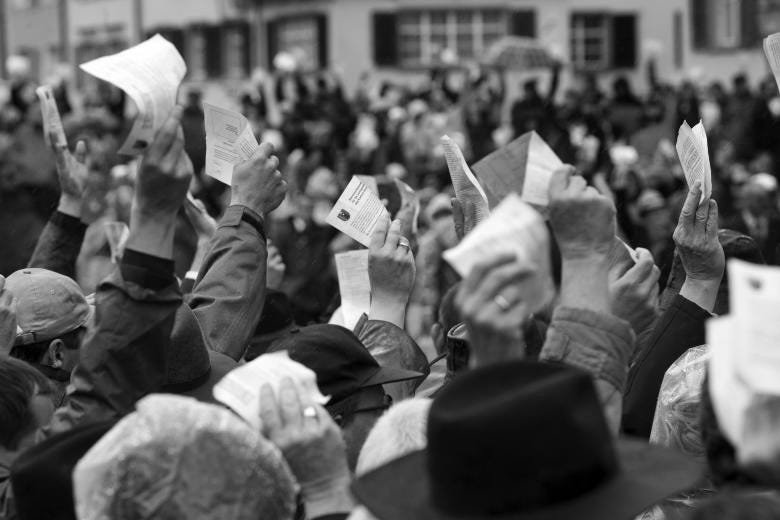
Even though sometimes we will win and lose in a democratic system that neither marginalizes nor disenfranchises any group, we win from the reduction of violence and social animosity, the positive-sum decision-making that emerges out of such systems, as the elimination of risk of exclusion from the process. In Democracy, we can use common metrics that of flourishing, including those pertaining to health, safety, economic security, prosperity, etc., to create rules that suit our ends.
It is helpful to remember that good and bad, and their ethical variants, right and wrong, are merely assertions of preference relative to the desired outcome. In our personal lives, something that produces more flourishing (for us) is good, and something that causes more suffering (for us) is bad.
Since ethics is inherently a process of making judgments on actions based on their social effect, a wrong thing is something that causes more harm than good to others, and the right thing is something that does the opposite. Calculations of ethicality are difficult because of how complicated it is to determine the total effect on well-being every rule and choice has. Thus we derive principles, which act as general rules of thumb that can be applied in order to make moral determinations easier.
Some principles suffer from being too general, such as that killing is wrong. Clearly, killing does not always produce worse outcomes. That is why we often narrow down principles to be more specific, such as "murder” is wrong, as in the killing of another for purposes other than justified reasons like the defense of others or oneself. It is nearly impossible to make principles specific enough to always be correct. Principles inform both rules and our personal choices. An essential truth we must remain cognizant of is that principles are only useful insofar as they guide us toward decisions that align with our desired outcomes.
Those who attempt to conflate man-made principles with divine, metaphysical, or natural laws misunderstand their origin and utility and, contrary to all reason, are willing to abide by principles based on an arbitrary feeling of their rightness rather than any exercises of their rational faculties.
From these verities, we can determine that it is broadly rational for us to cooperate with others in order to formulate rules based on approximations of aggregated preference routed in our shared desire to live flourishing existences. Since we are social creatures and thus have a connection between the well-being of ourselves and the well-being of others, have certain universal metrics by which to judge the effect of decisions on our flourishing, and since the alternative options afforded to us have demonstrated themselves both empirically and rationally to be inferior.
II. PROPERTY AS RULES
The economy is a collection of rules. Rules define what property is, who can own it, how it can be acquired, what ways it can be transferred, and so on. Taxation is one kind of rule that is present in economic systems. Others pertain to the formation and enforcement of contracts, how labor can be purchased, the structure and abilities of economic actors like corporations, labor unions, and non-profits, and it goes on and on. The point is everything within the economy is determined by rules. Rules, like all things, must be judged based on their relationship with the outcome we desire.
Contrary to what is frequently claimed, these rules clearly have no connection to any metaphysical laws of reality, nature, or otherwise. The rules of property and the economy have always changed throughout history. Initially, property did not exist. The earth was unowned and had its lands, its wildlife, and its resources appropriated based on a first come, first serve basis.
As humanity progressed from sparsely scattered hunter-gatherers into semi-formal communities, rules were created. Some rules were upheld by force, usually with wildly autocratic/oligarchic mechanisms of rulemaking. Others were informed by basic mutually recognized norms informed by simple evolutionarily evoked principles. In small tribes, this principle may be a distribution of resources based on need. When a small, mostly familial group ate, they may have distributed to each member food according to an estimation of their requirement, with possibly some altruism exhibited by parents (due to their parental instincts).
At other points, when multiple groups of humans collided over an area, they may have settled their dispute based on some norm, such as the equal splitting of something or the full seizure of it by the male who proves themselves to be dominant over the other head of tribe. Avoiding too deep a dive into anthropology, a clear element of both primitive human society and even animal society, is emergent rules of property.
Similarly, as time has passed and new economic systems emerged, we have seen over and over again new property regimes routed in the desired outcomes of a specific, usually small group within the population. They have made their own arbitrary rules and imposed them on everyone else. As time has gone on, the structure and complexity have social systems has grown, and the general population has developed greater capacities for critical thinking. This has produced within those winning within an oligarchic system the necessity to invent reasons for why the property rules are justified.
In the days of feudalism, the property system which monopolized the earth’s resources and land into the hands of competing hereditary tyrants justified itself based on clearly preposterous claims about their "divine rights” and through supporting institutions of mass deceit like their state-sponsored churches.
In the days of slavery and mass subjugation of women, similar fictitious narratives were invented by those benefiting from the abusive property rules that, too, this system was "just” due to an assortment of claims about the inferiority of both enslaved people and women, along with many other narratives. More still, in the days of pre progressive era, where monopolists employed children in horrific conditions, new arguments emerged to justify the rules that be. Social Darwinism asserted that the massive disgusting abuses of the time were simply naturally emerging products of survival of the fittest.
Claims of intrinsic rightness and wrongness should always be looked at with skepticism, first because they misunderstand the origin of ethics and the value of principles, as mentioned earlier, but additionally because they clearly have an absolutely terrible track record. The idea of a fixed objective moral code has historically been a cudgel used against the general population in order to impose upon them the preferences of a select group of the population.
In the case of property, this is even more so true. There is not and can be no intrinsic definition of what property rights ought to be because "property", as Proudhon so famously put it, "is theft". For property to exist, it must first be seized from nature. Even if we accept the fallacious notion that our intuitive principles of justice are correct, there can be no justifying this.
If we believe that people ought to receive the value of their labor, how can we possibly approach nature? No creature, most definitely not any human, created nature with its vast lands, resources, and so on. Maybe some will contend that a good principle we can use when it comes to things no one produced is equal splitting. This, too, is not applicable. Nature is of massively differing quality, and the population is of ever-changing quantity. A pie cannot be evenly divided among an ever-changing number of people, let alone something as entirely heterogeneous as the totality of the earth, if not, by extension, the entire physical universe.
III. THE ARGUMENT
To avoid strawmanning the argument for why Taxation is Theft, I will quote directly from Michael Huemer of the Libertarian Party. Then I will, building on the framework I have established thus far, show where, how, and why he is wrong.
"Imagine that I have founded a charity organization that helps the poor. 1 But not enough people are voluntarily contributing to my charity, so many of the poor remain hungry. I decide to solve the problem by approaching well-off people on the street, pointing a gun at them, and demanding their money. I funnel the money into my charity, and the poor are fed and clothed at last.
In this scenario, I would be called a thief. Why? The answer seems to be: because I am taking other people’s property without their consent. The italicized phrase just seems to be what “theft” means. “Taking without consent” includes taking by means of a threat of force issued against other people, as in this example. This fact is not altered by what I do with the money after taking it. You wouldn’t say, “Oh, you gave the money to the poor? In that case, taking people’s property without consent wasn’t theft after all.” No; you might claim that it was a socially beneficial theft, but it was still a theft.
Now compare the case of taxation. When the government “taxes” citizens, what this means is that the government demands money from each citizen, under a threat of force: if you do not pay, armed agents hired by the government will take you away and lock you in a cage. This looks like about as clear a case as any of taking people’s property without consent. So the government is a thief. This conclusion is not changed by the fact that the government uses the money for a good cause (if it does so). That might make taxation a socially beneficial kind of theft, but it is still theft.”
"If taxation is theft, does it follow that we must abolish all taxation? Not necessarily. Some thefts might be justified. If you have to steal a loaf of bread to survive, then you are justified in doing so. Similarly, the government might be justified in taxing, if this is necessary to prevent some terrible outcome, such as a breakdown of social order."
These excerpts represent nearly the entirety of his argument in the abstract, but feel free to read his brief article if you desire to see him elaborate on these points.
To start, we can identify that Michael uses a quite silly definition of Theft. He defines theft as "taking without consent” and thus argues that #1 taxation is theft because it is taking without consent and #2 that theft is usually wrong but sometimes ok. The problem is that this does not match either the legal or moral definition of theft.
If we use either definition, we see that it is impossible for both of his points to be true at once. If we are using the legal definition of theft, then taxation is most definitely not theft, for obvious reasons. The same state who defines what theft is, i.e., the illegal seizure of someone's property, is the one that taxes.
By the legal definition, it is actually not paying taxes that is theft. If we use the moral definition of theft, the reverse contradiction emerges. Theft is the "wrongful taking” of someone else’s property. Theft in the moral sense is wrong by definition. You cannot wrongfully take something (i.e., commit an act that can be considered morally "theft") and be right in doing so. That is like saying sometimes it is totally ethical to murder someone (in the moral sense). It is a contradiction in terms.
So if we use his definition of theft as a moral one because it clearly can't be a legal one, we see that while it can be true that taxation is theft, it is simultaneously true that sometimes theft is ok. If his argument was to make sense, it would read instead "that taxation is taking” because taking is morally neutral. Sometimes taking is bad, sometimes it is good. It, unlike theft, can be both. But an article entitled "Taxation is Taking” wouldn't sound very profound, now would it?
Michael’s argument showcases the mind games that have to play in order to come to such a ridiculous conclusion. According to his own argument, right and wrong are descriptions of relation to some social outcome. Therefore nothing in itself has any moral quality. By this logic, taxation can be theft only insofar as it generates negative outcomes at the social level, but conversely, it can also be justified. He recognizes, maybe not fully consciously, that ethics is a process relative to outcomes, not an assortment of intrinsic self-asserting truths.
Yet he makes the err of defining theft as if it is morally neutral, which it is not, and then mis-asserting that a principle that is generally true for individuals is also generally true of the government. Another excerpt from his article showcases this.
"Why, then, does it matter whether taxation is theft? Because although theft can be justified, it is usually unjustified."
If we substitute in his definition, we can translate his argument into one that is far clearer so that we can further scrutinize its elements.
"Why, then does it matter whether taxation is” taking without consent"?" "Because although" taking without consent “can be justified, it usually is unjustified."
With the converted phrase, we see that Michael is making an argument based on principle. He thinks that taking without consent usually generates bad outcomes, although sometimes it doesn't. This is a true statement if we take it on the individual level. Surely more times than not, one of us seizing the property of others without their consent will not make society as a whole better off. In most cases refraining from taking other people's stuff is the socially ideal thing to do.
But this statement of principle does not necessarily have any wisdom to offer us at the social level. A principle that is true for us as individuals should not be assumed to be true for us as a society. We would consider it a general principle that It would be wrong for an individual to detain someone and hold them captive for years on end, but at the social level, that is generally viewed as appropriate given that the grounds for detainment were justified. Now just because something is generally viewed to be right or wrong doesn't mean it is. But it does show that there is a common recognition that principles are useful in certain instances and not useful in others. Certainly, sometimes principles can be universally applied, but Michael doesn't give any reasons why in the case of this principle, it should. The burden of proof is on him to show that the principle that taxation usually produces negative outcomes an argument that is far harder to substantiate and requires way more nuance than blanked moral declarations.
But ignoring that fact, let’s pretend like Michael did provide a reason why we should believe in the principle that taxation is usually harmful; what then can be said? A lot, actually, that claim struggles to offer us much utility. As we have covered, taxation is simply a rule in the property system. Property is fundamentally a social concept; without the recognition and respect of others, an individual’s perception of what is theirs is irrelevant.
If we imagine an existence with only one being in it, would it make any sense to say they own any individual part or aspect of the universe? Not really. We could say they own the entirety of everything, but in effect, that is no different from saying they own nothing at all. Ownership exists and can only exist insofar as it gives a select being or group exclusive rights to something. It is a social determination.
Taxation is just a rule like all others. It does not merit any distinction from any other economic rule. When Michael talks about taxation, as in taking from someone without their consent, he forgets that in order for something to be taken from someone, they had to own it in the first place. Their very owning it is a product of rules! If we lived in an ideal world, taxes would not exist because no one would receive in excess of what we have determined to be the best system for our flourishing. But unfortunately, the world doesn't work that way. A lot of rules that are generally beneficial produce distributional outcomes that are not ideal. A system based on the market provision of goods and services and income distribution according to capital ownership and wage labor will often fail to produce the most desirable outcomes.
In such a system, certain rules that fall under the classification of taxation are clearly beneficial for us. It has been widely substantiated that a rule (tax) that a certain set percentage of land values, often 5%, but it varies, be paid to the public would boost efficiency and reduce inequality. Similarly, many different rules exist (taxes) or have been proposed that would, in different contexts, require individuals that cause harm to others that is not reflected in their costs to compensate others for the harm they cause.
The exact specifications of which taxes and spending approaches are ideal is the topic for another day, but the point is that taxes are just like any other rules. Just like rules determine the pre-tax distribution of incomes, rules also determine the after-tax distribution. When we collectively determine through whatever decision-making process we have established to put in place taxes, it is not our enforcement structure, ie, the government, imposing some special intervention in the property system, rather it is us identifying that the other rules both in forms of law and norm in existence have failed to provide the distribution most in line with our desired outcome.
When we look at the current economic system and postulate about ways we can reform it to produce better outcomes, we should not be asking, should we take more from the rich? Rather we should be asking: is it beneficial to continue giving so much to the rich? The former questions accept the fallacious notion that taxation is a unique and arbitrary rule that changes the distribution when in reality, taxation is just like any other rule.
If there is anything we can learn from the history of property, it is most certainly not that we should abide by some binding set of principles. Rather it is that to produce outcomes likely most in line with our flourishing and the flourishing of others, we should fight for a system that incorporates and weights equally the preferences of more people, and that system I can guarantee taxation would be retained. Why? Because in many cases, it is in our interests for it to exist.
The whole anarchism section is wildly misinformed
We have ethical ways of pursuing our own flourishing while not interfering with others: its called individual rights and the non-intiation of force.
The moral calculations you suggest are abhorrent. You both suggest that humans do not have free will to live their own lives and suggest that they need a paternal government that knows better.
How do they know better? well, because they have data. How did they collect this data? they stripped all human value from data, aggregated it all together to remove all nuance, applied a consequentialist morality to it that is rooted in moral intuitive judgements and said 'walla! The government can now make moral decisions on how you should lead your life. We're from the government, and we're here to help.'
Not that I am for anarchy, but this post lacks any principled outlook on human flourishing frameworks.
We've been experiencing democracy for a while now. We have massive interest group fighting, regulations that halt all progress, a bureaucracy that cripples any progress and increasing costs of government services reaching unsustainable levels... Maybe this consequentialist framework isn't working out as much as you would have hoped.