



[prelude]
When a person litters, we believe it's bad, but we seldom wonder why they do it. Littering is convenient. Sometimes, there isn't a trash can nearby, so tossing an empty water bottle on the ground is the easiest course of action.
But what's convenient for individuals can be bad for others. Standing up at a lecture may give you a slightly better view, but at the price of everyone behind you having a much worse view.
While littering is bad for society, any single individual sees practically no benefit from ceasing to do it. Their contribution is inconsequential in the grand scheme of things. So while there is a convenience benefit from engaging in the behavior, practically speaking, there is no cost for doing so other than some momentary guilt (unless you are unlucky enough to actually get caught and fined).
A similar story is true for businesses and carbon emissions. While carbon-emitting activity does worsen climate change, which imposes substantial costs on the world, one company ceasing the practice will hardly have an impact on the climate sufficiently large enough to make up for the profits they lost from adopting such measures.
In both cases, the concept of negative externality is abundantly clear and well understood. Most people get that in markets, not all the costs of a person’s behavior are necessarily borne by them, which can produce situations where it is in the interest of individuals to do things that leave society worse off.
In response to the externalities of the market, along with its other flaws, many have looked to democracy as an alternative. For the most extreme of market critics, this can mean extensive state ownership; for the more moderate, this can mean regulation or externality pricing. What is important is that insofar as the market fails, a common thought is that the government should swoop in to correct the error. Put differently, actors in the market, which mostly only care about profit, should be subjected to democracy, which can be expected to put the common good first.
The issue is, as we far too seldomly acknowledge, externality is just as endemic, if not more common, in political systems, even democratic ones. This produces policy failures, many of which we observe all the time. Let's consider some examples.
In the United States, welfare programs, while somewhat successful at reducing poverty, often create problematic welfare traps where choosing to work actually results in a reduction in income.
Government intervention in land use has led to the cost of housing skyrocketing, pushed up transportation time and expenses, and contributed greatly to the obesity crises, the visual decline of built environments, the productivity growth slowdown, and excessive emissions.
Ethanol requirements, subsidies to fossil fuels and sugar, and the employer-sponsored insurance mandate all directly work to promote, not impede, activities with negative externalities.
Occupational licensing, which had the stated aim of improving the quality of service and increasing safety, has largely done no such thing. Rather, in many cases, it has had little discernable impact on quality, increased costs, and contributed to a deepening gap between non-credentialed and credentialed workers.
All across the OECD, study after study has shown that, as a general rule, state-owned firms perform worse than comparable private firms, even in countries like Norway. Furthermore, privatizations have, on the whole, led to substantial improvements in productivity.
There are endless examples.
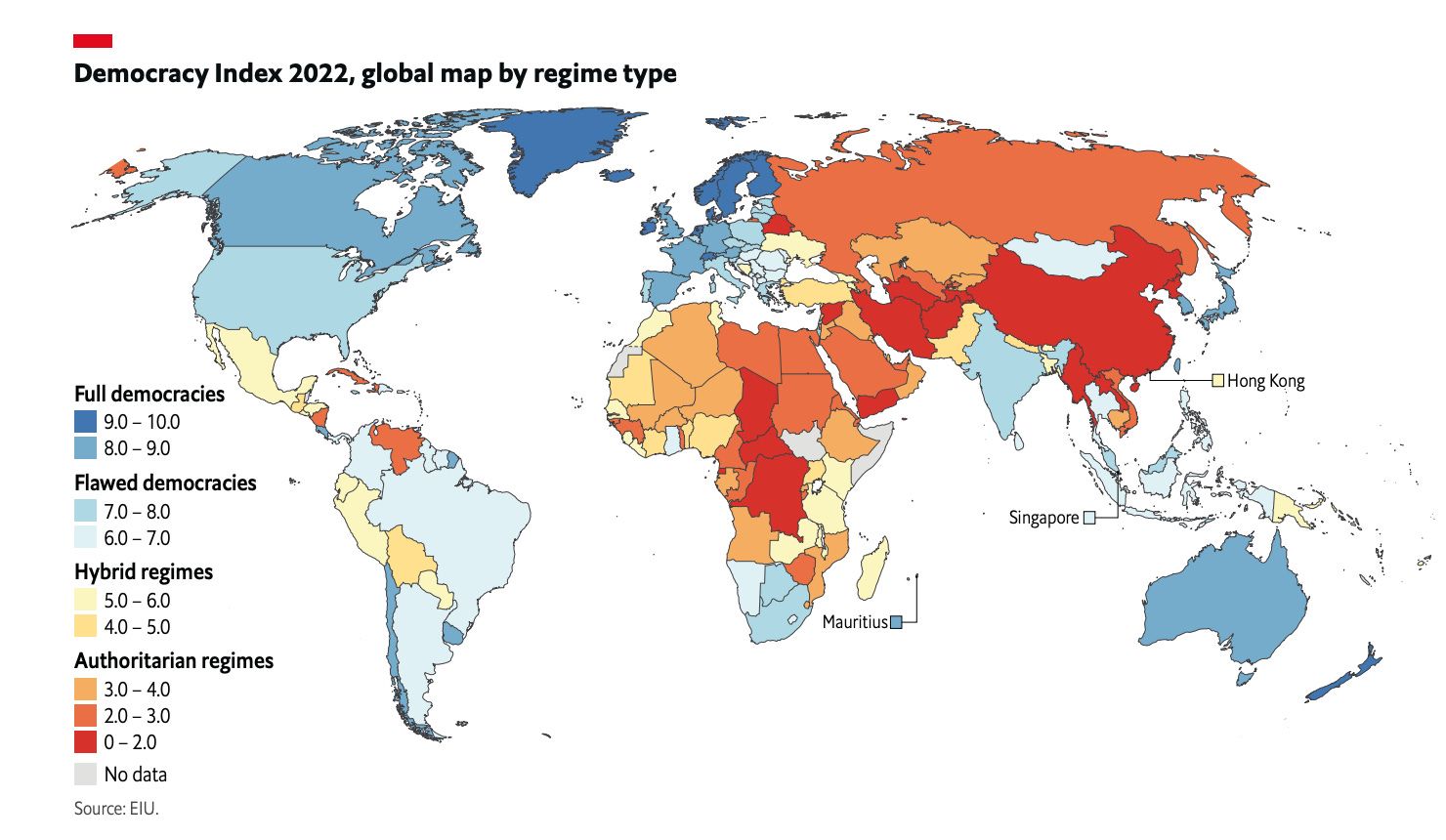
The incompetence of the government in administration and policy-making is not just the product of a lack of proportional representation in the US or too much leeway for private political donations in Australia. While it is true that systemic features in these regards do have an impact, we would be remiss to think we would be destined for utopia without them. In many ways, the flaws within our current governance boil down to the fundamental aspects of democracy as we currently conceive it, thus why even in places where political institutions are more democratic from an institutional perspective than, say, the US (like Italy, France, Spain, Costa Rica, or Mauritius) awful policies still often rule the day.
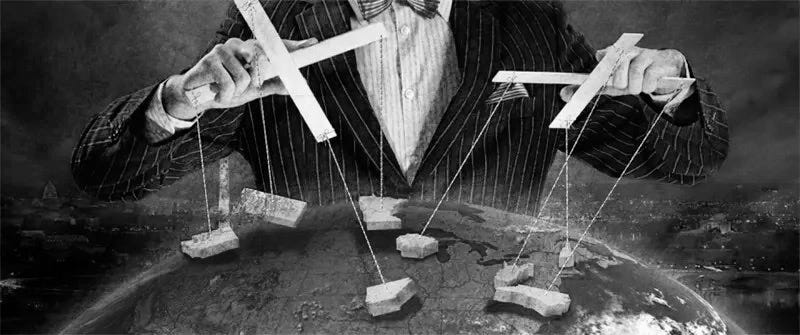
Governments aren’t controlled by flawless, benevolent, and omniscient beings. Like all other human institutions, they have irrevocable flaws and are filled with constrained agents that often have interests that differ greatly from the whole. Comparing imperfect markets to an idealized form of democracy is, as economist Harold Demsetz put it, a “nirvana fallacy.”
Whether it be voters, politicians, or bureaucrats, all groups within political processes can frequently find it personally beneficial to engage in behaviors that harm others. These misalignments go a long way in explaining the faults in current public policy.
This realization has clear ramifications for how we view democratic government in its current form and its capacity to provide a favorable alternative to the shortcomings of markets.
Part 1 of this series will rest on addressing the ways externalities in voting can produce government failures; in Part 2, I will cover failures pertaining to politicians and then, finally, in part 3, failures relating to bureaucrats.
Blame the Voters
We like to think that when the government does bad things, it is doing them against the will of the people. Such thoughts maintain the comforting fiction that the public is never wrong and that every time something bad occurs, even more democracy is the obvious solution. Such a position, though, is contradicted by the facts. Many times, governments do bad things not despite but because of the people’s demands.
In Germany, nearly all political parties were reluctantly forced to adopt an anti-nuclear position due to public outrage. In Denmark, a hyper-nativist consensus has been fostered by the deeply prejudiced views the population has developed towards immigrants. Just recently, the Dutch ruling coalition faced an electoral disaster for adopting environmental policies intended to lower emissions.
Looking back on American history, we can observe a similar story. Segregation had majority support up until the 60s, and even as the Civil Rights movement came about, it hardly had a clear majority; Clintons gutting of welfare in the 90s was extremely popular; the war on terror and the Iraq war it spawned happened with overwhelming public backing. Even today, the increasingly protectionist trade policies that both parties have adopted have been ushered in by the views of the population.
Every time a referendum goes against what the genuinely correct policy is, the democratic process in place has produced a bad outcome. Furthermore, on each occasion that the government mismanages a state-owned enterprise, botches a regulation, or gives out an inefficient subsidy, our political institutions have failed us.
Contrary to popular belief, giving the people power doesn't necessarily entail the common good prevails. Due to rational ignorance, the ironically named rational irrationality, and the necessity of foreign exclusion, many times, voters can find it in their interest to support policies that, on the whole, make the world worse off. We can argue that alternative institutions could reduce their poor decision-making, but if we are to make a fair comparison between the capacities of government and markets in the world as it actually exists, we must recognize these misalignments.
a. Rational Ignorance
Americans don't know very much about politics. On average, they think that foreign aid spending is 31% of the federal budget. It's actually less than 1%. Embarrassingly, only 36% can name all three branches of government, and 35% can't name a single one. If you select an American at random and ask them what they thought of the 2020 election, around 40% will tell you it was “stolen."
Books can and have been written about the depth of misconceptions voters have in the United States; what is important to note is that similar errors, albeit often of a smaller magnitude, happen in all Democracies.
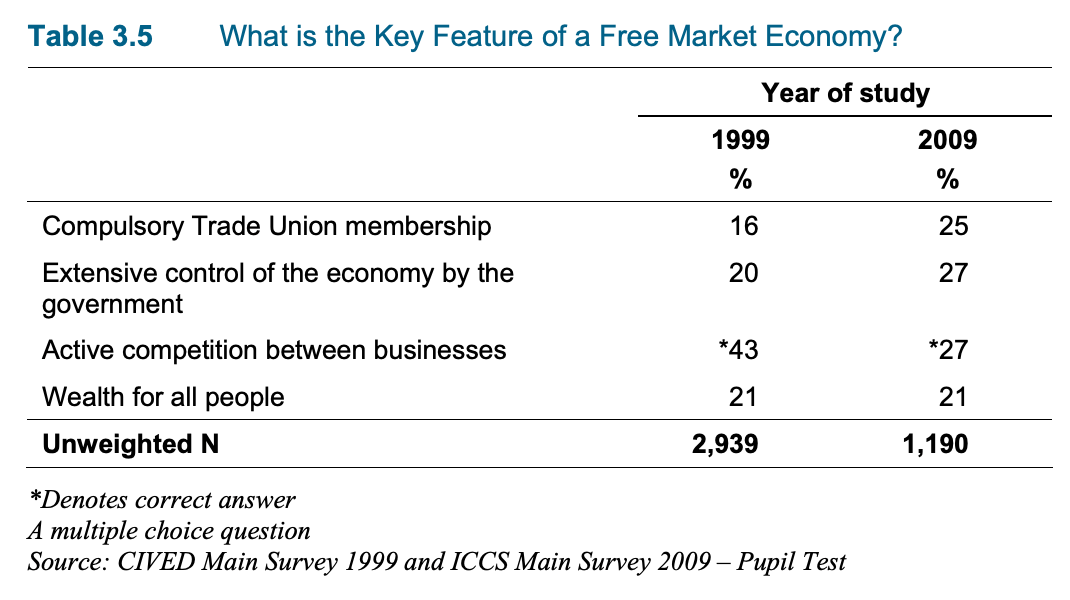
An unfortunate fact is that in politics, it is entirely rational to be ignorant. Being informed about things takes a lot of time and effort. Effort is only accepted when the expected rewards exceed the cost. Yet, in the case of politics, the expected rewards are almost nonexistent.
The odds that any individual person’s vote decides an election are infinitesimally small. In fact, you are more likely to be killed while driving to a polling location than to be the vote that determines which party takes the white house.
Knowing relevant political facts provides little utility in most people’s lives. To the extent that any person who is not directly involved in policy knows about the issues, they probably do so because they find it interesting, not because being an informed voter enhances their life in any meaningful way. Nearly all the benefits of voters being educated are necessarily external.
This calls into question a basic premise of democracy that people, when given the reigns of power, will be informed enough to support policies that leave society better off. While voters may know what end states they want to achieve, whether it be greater equality, more prosperity, or increased safety, in all but the simplest cases, they hardly know what policies actually bring about that state, outside of the instances where the answer is overwhelmingly obvious (i.e., disallowing murder will increase safety, etc.).
It would be foolish to expect anything different. Just as a parent not wanting their kid to have a brain tumor does not automatically equip them to perform brain surgery, a voter wanting what’s best for society hardly has the expertise to know how best this end can be achieved. Wanting something and knowing how to get it are two entirely different things.
b. Rational Irrationality
But Rational Ignorance alone is not the nail in the coffin of the notion of near-optimal voter behavior. The case can be salvaged if the wisdom of crowds/miracle of aggregation holds true. It may be possible that the massive majority of voters who are deeply misinformed make random errors.
Essentially, they show up at the polling place and flip a coin. Under this theory, uninformed people are just as likely to baselessly oppose a carbon tax as they are to baselessly support it. In the end, since these errors are random, they cancel each other out in the aggregate.
So, as long as the errors do not skew in any one direction and democracy is majoritarian, we have nothing to be concerned about. In that case, the only people who actually decide elections are the informed. Unlike the uninformed, they don't flip a coin and, thus, as a group, don’t cancel each other out. They vote one way or the other. Given that these informed voters are decent at ascertaining the correct positions, everything should be fine.
The only issue is this is not what happens in the real world. Uninformed voters aren't split half and half on every issue; rather, they systematically hold certain positions over others. This leads to many bad positions, having a majority of support.
Of course, a perfect approximation of the divergence between the public's views and the correct views is not something any one individual can know with certainty; that would require one person to have the correct on every issue. I, for one, am definitely not keen on this knowledge.
But it is possible to at least roughly approximate the gap if we accept that experts on a topic are more likely to be correct than informed laymen.
When doing this, we see some pretty big differences. For starters, consider the following results from the highly comprehensive 1996 “Survey of Americans and Economists on the Economy” on what economic issues were holding the United States back at the time.
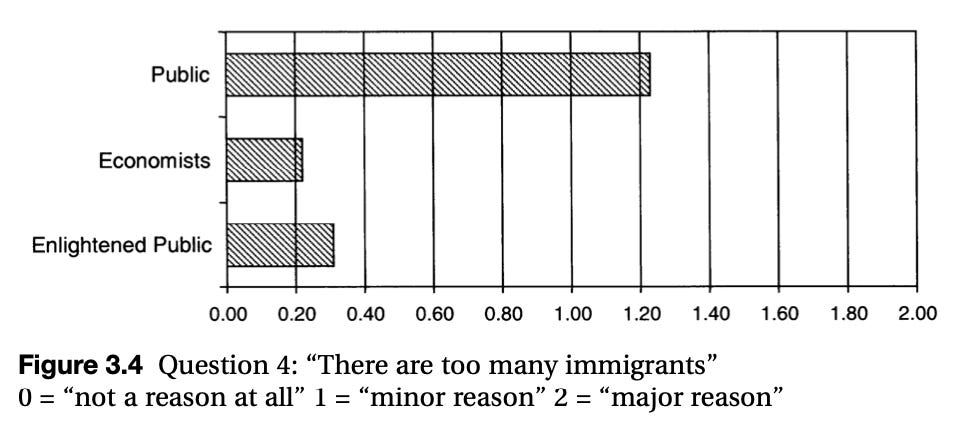
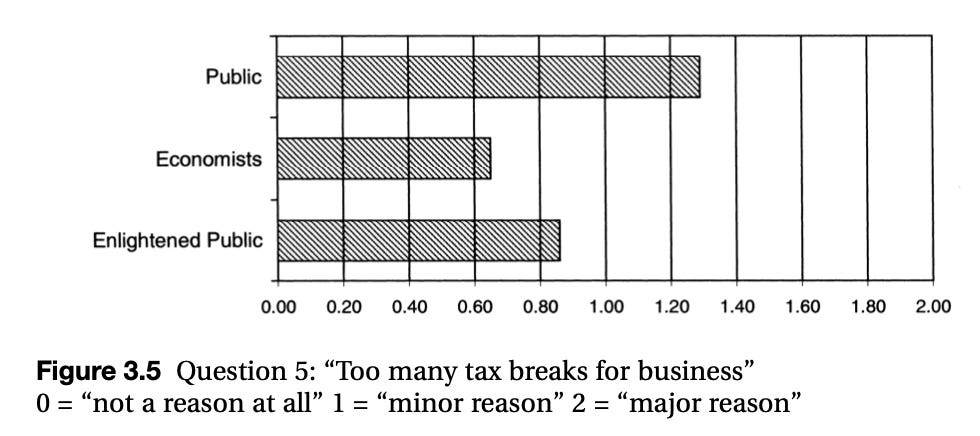
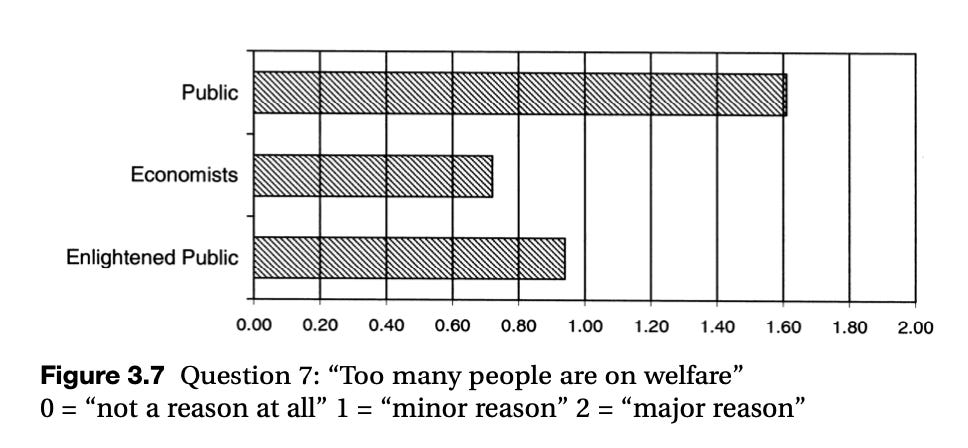
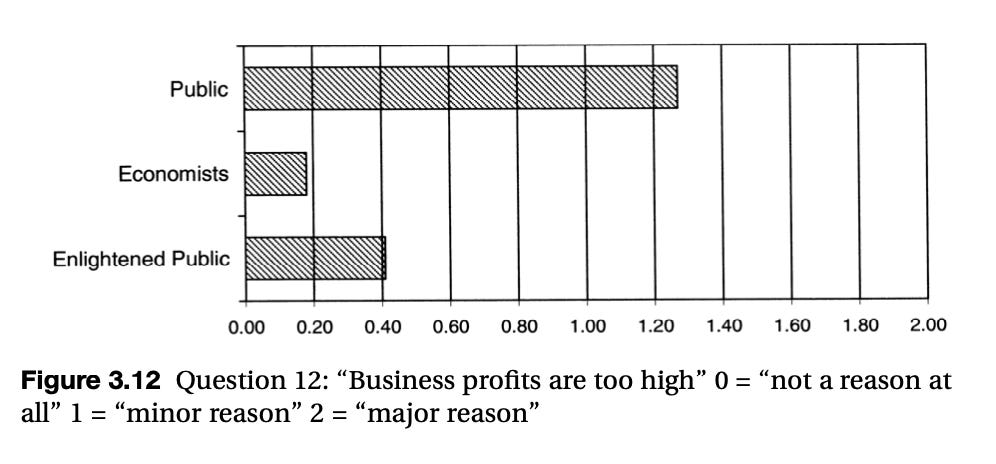
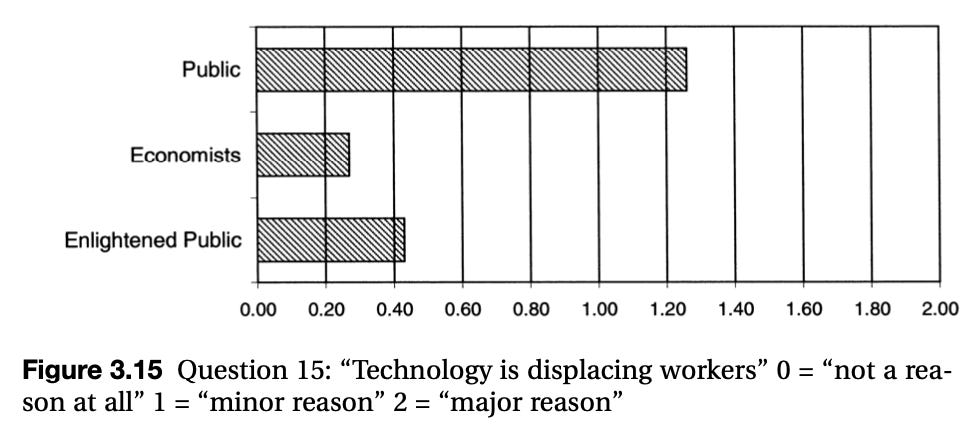
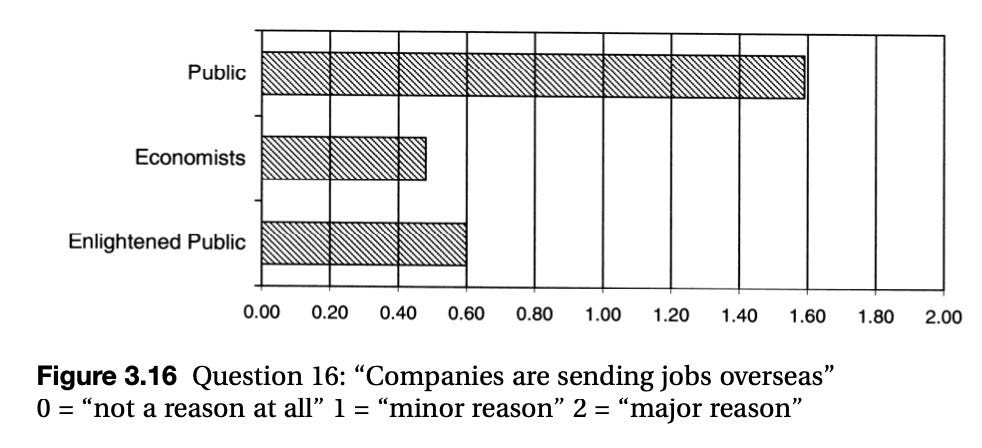
As can be seen, there are clear and large differences between how the public and those with a better understanding of economics view economic issues, and these can't be explained by differences in demographics.
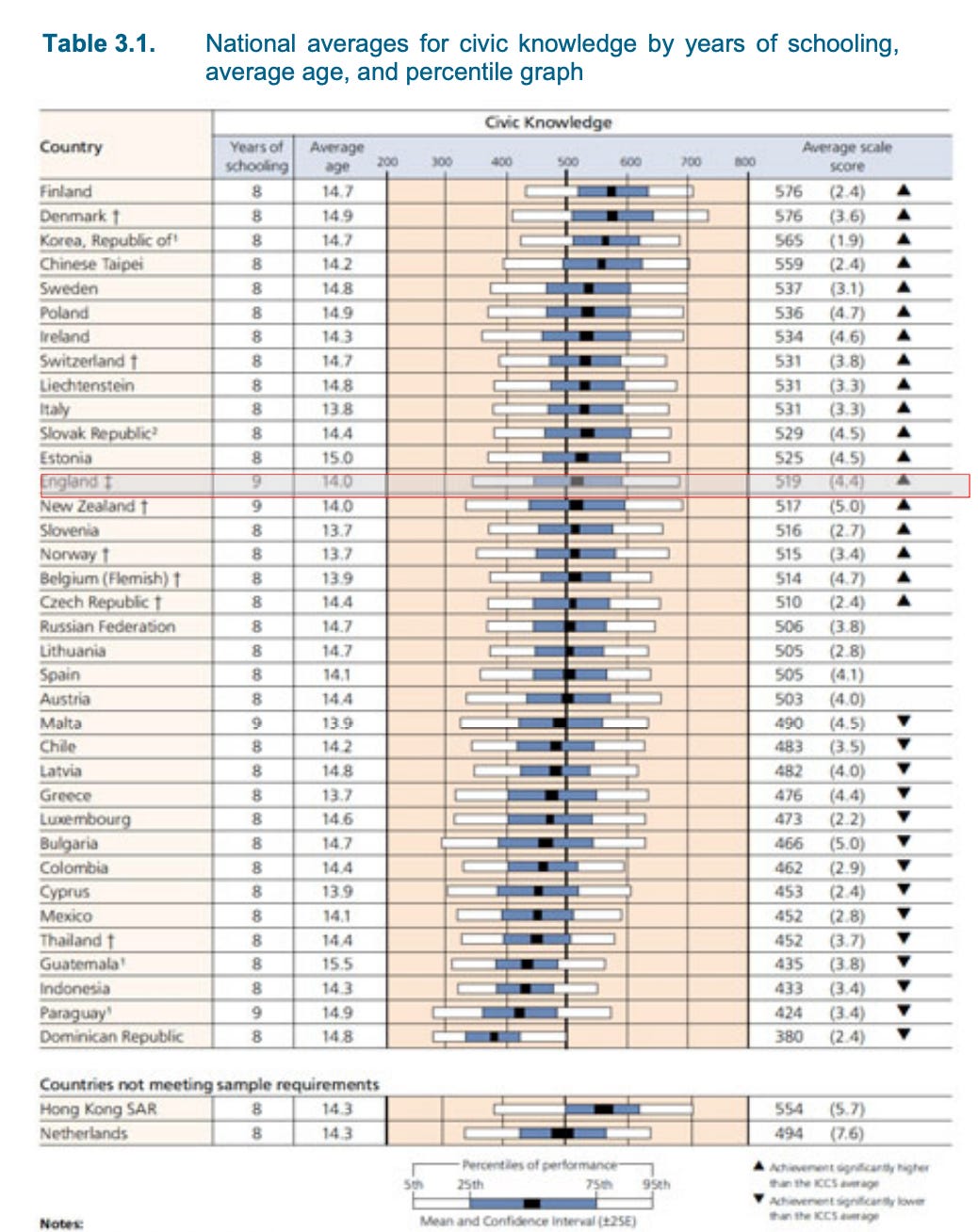
A study by Scott L. Althaus in 2003 had similar findings; according to his extensive research, voters who have high civics knowledge, regardless of income, tend to favor markets a lot more than those who don't.
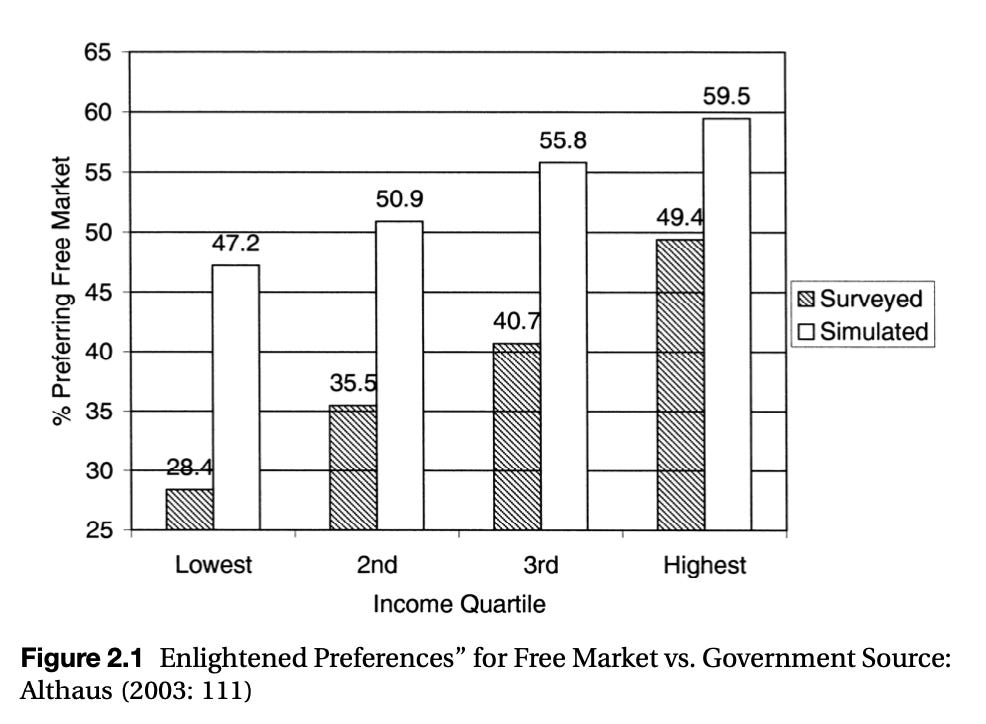
As Bryan Caplan notes in his landmark book, The Myth of the Rational Voter:
“The jury is in. People do not understand the “invisible hand” of the market, its ability to harmonize private greed and the public interest. I call this antimarket bias. People underestimate the benefits of interaction with foreigners. I call this antiforeign bias. People equate prosperity not with production, but with employment. I call this make-work bias. Lastly, people are overly prone to think that economic conditions are bad and getting worse. I call this pessimistic bias.”
I would add, specifically, in the American context, there has seemed to be an anti-poor bias, which has lingered in the public mind as well. Whereby people of genuine unfortunate circumstance have been made out to be lazy, thuggish, or any other matter of inaccurate things.
Yet we need not look decades into the past to find these differences; despite the lack of recent equivalently robust scholarship, there are still many signs that these differences persist to this day.
Gallup found in 2017 that around 60% of Americans thought there should be limits on the number of jobs businesses can automate away, with their idea being that wide-scale automation will lead to a substantial reduction in employment. On the other hand, another poll found that 76% of Economists agree that advancing automation has not historically reduced employment in the United States, with 23% either having no opinion or being uncertain.
Another example can be found in polling over inflation. In 2022, over 50% of Americans believed that corporate greed was a key driver of inflation. In that same year, a Chicago Booth Poll of expert economists found that only 10% of Economists agreed with that narrative.
Yet polls tell only a part of the story. Sometimes as the following David Shor tweet discusses, voters reject initiatives they supposedly support at the polls, even when the massive bulk of the spending is in favor of the side they supposedly support.


Most plausibly, this is due to some form of status quo bias.
Ultimately it seems like the public and economists tend to still differ substantially on the issues, even when they pertain to broad questions and not just the more technocratic elements of policy. Divergences between the public and experts persist on other issues within policy as well. Whether it be on hormonal replacement therapy, GMOs, or vaccines, gaps persist all over the place.
The explanation for these gaps comes down to the aptly named phenomenon: rational irrationality. In the same sense that being informed is costly, being rational is costly too. It requires people to overcome their biases, abandon their cherished political affiliations, and be neutral when they haven't studied the issues. As established, people only accept costs when the expected rewards exceed those costs, which is generally untrue in the realm of politics.
We are rationally irrational all the time. For instance, when at an ice cream shop, taking the time to perform an in-depth study of all the information you have on all the flavors in order to discern the one that would have the most pleasurable to consume would be, in some sense, rational, but it would also be a massive waste of time.
The time and effort cost of methodically doing so would surely outweigh any of the marginal benefits you receive from getting two scoops of oreo with one scoop of caramel instead of going for three scoops of rocky road. For this reason, we result to our intuitions. Rocky Road looks tasty, so we go for it. In other words, we make the rational decision to be imperfectly irrational.
Politics is a bit more complicated than ice cream, but to an individual, the reasoning is the same; the benefits of being irrational in politics are manyfold, and the cons are almost nonexistent.
Research on the Dunning-Krueger effect showcases that humans tend naturally to think they understand things far better than they do; choosing to be rationally irrational means we don't have to take the time and effort required to contain this bias. Allowing this cognitive deficiency to run wild can be quite pleasurable. We like the feeling that we know how the world works and what policies are better than others. Not understanding things can be frightening, and so we often generate our own explanations, even when these have little grounding in facts. This is why humans, for 1000s of years, ascribed weather events and medical plights to the doing of some divine being(s) rather than simply admitting they had no idea why these things occurred.
In conjunction, irrationality allows us to retain our other biases that emerge from cultural, evolutionary, and other sources. An irrational voter doesn't need to confront their in-group bias, which makes them prejudiced against members of society they don't share much in common with and foreigners. Nor do they need to confront certain cultural biases that may cause them to assume views that are irrational. A great example of the latter case frequently appears in African countries, whereby the public shows broad support for the legal marginalization and oppression of homosexuals.
It also means we don't need to relinquish the political perspectives that are so important to our cherished personal identity and socialization. After all, politics is not just about policy; it's also about team sports. For many people, their ideology is a big part of who they are. We tend to care deeply about this identity and get defensive when it's under threat. In addition, our identity can act as a cultural touchstone that allows us to form bonds with others. There is a certain pleasure that two conservatives get from feeling that they are part of the same enlightened team, engaged in a grand struggle against members of their outgroup.
All these benefits come with cons that are meager at best. Having wrong views on politics, let alone any other mostly abstract topic has no clearly discernable negative effect on our lives.
Today, a surgeon can get by just fine in believing that being gay is a choice (despite no supporting research) and that Obamacare is the worst thing that's happened since slavery; Ben Carson does just that.
If you discerned tomorrow that rent control actually increased the supply of housing, the war on drugs has been very effective, and automation was bad for the economy, your day-to-day life would scarcely be impacted.
Politics is among those select areas where being incorrect has very few downsides. An engineer who rejects gravity will quickly lose their job. Similarly, a fast food worker who believes that soap is a good condiment will be fired if not sued. In these cases, the costs associated with being wrong outweigh the costs of being right. But in politics, there is no such feedback. To the extent that your political views affect your career (given you choose to voice them publically), this doesn't always push you toward the correct view.
Voicing support for free immigration may get you shouted down at a family dinner, despite the fact that the position, at least according to current research on the topic, is quite reasonable. Conservative areas push people towards conservative positions, and liberal areas push people towards liberal positions. Neither pushes people towards what is necessarily the correct position on each and every issue.
In brief, satisfaction received from having a correct view vs. a wrong one is indistinguishable, yet coming to the correct view requires immensely more effort. This means that for most people, excluding those that find studying issues intrinsically pleasurable or people who make a career out of studying issues, it is most rational to have an opinion even when uninformed. In the aggregate, this leads to a large gap between public opinion and what reflects consideration for the common good.
c. Necessity of Exclusion
The final hiccup in the notion of voting accurately and producing decisions that are in line with the common good is the necessary exclusion of foreigners. Foreigners are deeply impacted by a nation’s policy, sometimes much more than the domestic population (invasions and occupations). Yet they get no say on what the contents of this policy are. In a world where they were, we'd imagine that wars of aggression would never essentially never materialize, trade restrictions would loosen, immigration barriers would be taken down, and climate measures would be put in place universally. But this is almost sure to never happen.
Unlike other interests, which are not included in the voting process either by their own choice (nonvoters) or by plausibly reformable law (the incarcerated), there is no clear-cut solution to this problem other than global federalism, which is almost sure not to materialize - at least not in a fashion that is democratic enough and powerful enough actually to resolve this problem.
From the aforementioned issues, we can see that there are significant externalities in the voting process, and thus we can expect and do see that the aggregate of voters’ opinions diverges greatly from that of what is in the genuine aggregate interest. This does not spell an absolute case against democracy, as doing so would require oligarchy or anarchy to be preferable (neither are) but, it does suggest two things. First, insofar as public policy is bad, it may be a structural inevitability of institutions that themselves must be reformed in order for us to expect long-run improvement in the quality of policy. Potentially alternative methods of Democratic decision-making, like lottocracy/sortition, may be able to help us avoid the issues thus far outlined with voting-based systems. Second, for the time being, comparisons between public solutions and laissez-faire must be tempered by the fact that any plausible version of a public policy is gonna far from its optimal variant.
This recognition is essential in ensuring that we only push for government intervention within areas in which government failures are outmatched by market failures. In future parts, I will talk about other areas where government failures materialize, both among elected officials and the bureaucracy.
Until then,
Bonne Journée
Does rational irrationality explain why so many Trump supporters can confidently proclaim the 2020 election "stolen" against all of the evidence otherwise?
I suppose proclaiming as such is a signal to in-groups that they are a member of the team, more than it is a carefully evaluated conclusion.