


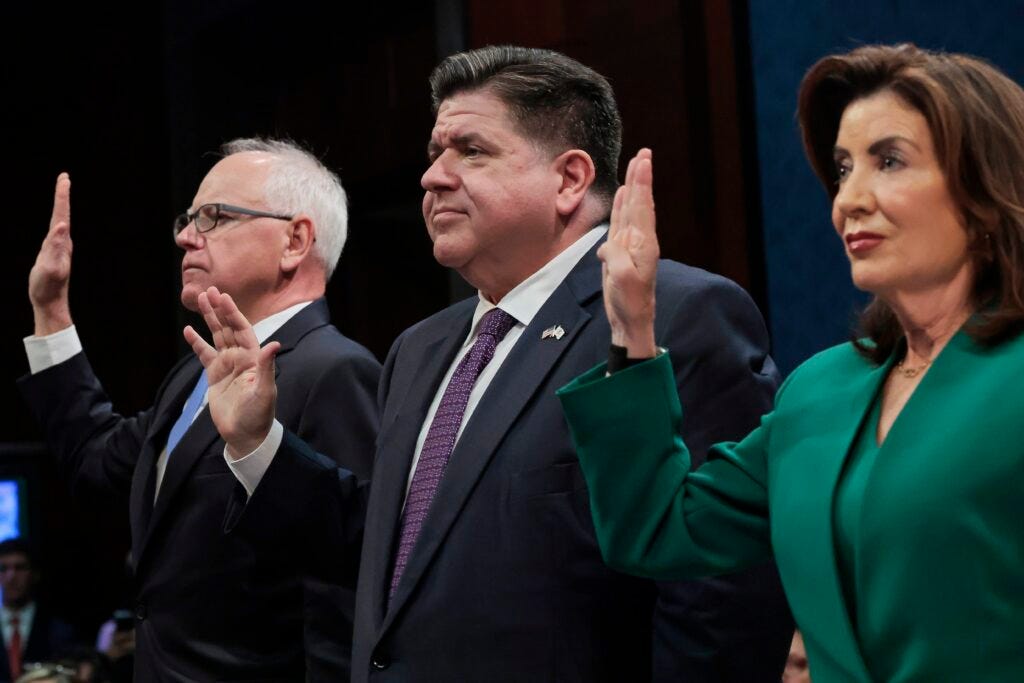
There’s a narrative that Democrats don’t have an agenda. That they’re the party of opposition, not action.
That narrative is wrong. And the proof is in the states.
While Washington has been paralyzed by Republican obstruction, blue states have been quietly governing. Passing laws, signing bills, delivering results.
1. Paid Family and Medical Leave
The United States is one of the only developed countries without a national paid family leave program. The federal FMLA guarantees up to 12 weeks of unpaid leave. But unpaid leave isn’t real leave for most workers. If you can’t afford to miss a paycheck, you don’t take the time off. You go back to work after having a baby. You skip the recovery time after surgery.
Democratic states have built real solutions.
Fourteen states and the District of Columbia have enacted mandatory paid family leave systems, including California, Connecticut, Massachusetts, New Jersey, Rhode Island, Washington, Colorado, Delaware, Maine, Maryland, Minnesota, Oregon, and Virginia. Nearly all use a social insurance model funded through pooled payroll contributions from employees and employers. Bipartisan Policy Center Minnesota launched in 2026. Delaware and Maine are coming online in the same year.
Wage replacement rates range from 50 to 80% across these states, and California’s program provides a maximum benefit of $1,620 per week, with higher replacement rates for lower-earning workers. Paycor
The payroll tax model is the right one. Costs are spread broadly, no single employer carries the whole burden, and the fund stays stable. This is how Social Security works. It’s how unemployment insurance works. The federal government should build a national program on the same foundation.
2. Free Community College, Trade School, and Apprenticeships
Every American who wants a good career should be able to get the training they need without going into debt. Community college. Trade school. Registered apprenticeships. The foundational education that connects people to stable, middle-class lives should be free.
Blue states are building this out.
Michigan Governor Gretchen Whitmer launched a free community college program for recent high school graduates with no income restrictions, setting a goal of 60% of working-age Michigan residents holding a postsecondary credential by 2030. Higher Ed Dive Massachusetts covers tuition and fees for all students regardless of age or income, with some students qualifying for an additional allowance for books and supplies. College Raptor Minnesota’s North Star Promise covers free tuition at all state colleges, universities, and tribal colleges, including trade programs and certifications, for families earning under $80,000. Scholarships360
These programs work. After Massachusetts launched its free college program, community college enrollment among adults 25 and older without a degree jumped 45% year over year. Higher Ed Dive.
3. A $15 Minimum Wage That Keeps Up Over Time
The federal minimum wage has been $7.25 an hour since 2009. Adjusted for inflation, it has lost nearly half its purchasing power since 1968. Republicans have blocked every effort to change it. Blue states stopped waiting.
Since 2012, 15 states have adopted a path to a $15 or higher minimum wage, including California, Connecticut, Delaware, Hawaii, Illinois, Maryland, Massachusetts, Michigan, New Jersey, New York, and Rhode Island. National Employment Law Project.
States have also solved one of the oldest problems with minimum wage policy: the political fight that has to happen every few years just to keep pace with rising costs. Indexing to inflation is now the law in nearly half of the states. Marketplace The most forward-thinking version ties future increases to median wages, not just inflation, so that as the economy grows, workers at the bottom share in that growth. A few states are experimenting with exactly that. It’s where the rest of the country should be headed.
4. A Universal Child Tax Credit
In 2021, the expanded federal Child Tax Credit cut child poverty in half. Then Republicans let it expire. Poverty shot back up. Democrats in the states didn’t accept that.
As of 2025, 15 states and D.C. provide Child Tax Credits for families with children. ITEP Colorado’s package is one of the strongest: lawmakers created a new Family Affordability Tax Credit worth up to $3,200 per child under 6 and $2,400 per child ages 6 through 16. Pn3policy Fully refundable credits are now available in California, Colorado, Maine, Maryland, Massachusetts, Minnesota, New Jersey, New Mexico, New York, Oregon, and Vermont. ITEP
The CTC should be universal — available to every family with children, fully refundable, and not phased out at the bottom. A system where the poorest families receive the least has it exactly backwards. States are leading the way. The federal government needs to follow.
5. Medicaid Expansion
The ACA gave every state the option to expand Medicaid to low-income adults. The results in states that took it have been clear. In expansion states, the uninsured rate among low-income adults fell by more than half between 2013 and 2022. Center on Budget and Policy Priorities
Ten states still haven’t expanded. An estimated 1.4 million uninsured adults remain in the coverage gap, concentrated in Texas, Florida, and Georgia. GovFacts Those are Republican-governed states that have chosen to leave their own residents without coverage rather than accept federal money. That’s a political choice, and voters should know it.
Medicaid expansion has now been adopted by 41 states, including D.C., and over 21 million people are enrolled through the expansion. KFF. Every one of those people has coverage they didn’t have before. Expand it everywhere, and millions more get the same.
The Democratic agenda isn’t nonexistent. It is largely composed of an array of popular, common-sense, center-left policies aimed at helping working people and families get ahead.
The notion that Republicans destroy and Democrats do nothing needs to go.
Democrats are delivering, and we need to talk about it.
The Community College point is really going to be more useful as AI becomes more prominent and wipes put many white collar professions. To give people a greater ability to gain new skills without the burden of paying for them is exactly what we need
Oregon is working toward a Universal, Single payer health plan. The plan will go to the Oregon legislature in September 2026!