

The Tariff Lie and Its Consequences
The deceptive marketing of the largest tax hike in American history


We live today under a regime that was unimaginable a year ago. Universal tariffs, on every single country, on nearly all goods, at substantial, sometimes eye-popping rates.
Trade Psychosis
We’ve been made four incompatible pitches on why these tariffs are a good idea:
Tariffs will reshore America’s industrial base.
Tariffs will eliminate our trade deficit.
Tariffs are a bargaining chip to get fair trade deals.
Tariffs will raise enormous, consistent revenue that we can use to replace other revenue sources.
These justifications, which are often repeated one after the other in the same sequence, are hopelessly inconsistent—a theme in Trump’s trade policy.
If tariffs reshore America’s industrial base (1), we won’t be importing all that much, which means the revenue tariffs raise will be paltry (contradicting 4).
If tariffs are but a temporary bargaining chip for fairer deals (3), then they won’t lead to the insourcing of all supply chain nor will they raise long-term revenue (contradicting 1 and 4). And so on, and so forth.
Even taken individually, none of these arguments withstands scrutiny. If tariffs are about bringing back manufacturing, why are they also being imposed on imports that we simply cannot practically source in adequate quantities domestically? Think coffee beans, bananas, and many raw materials.
If they’re meant to eliminate our trade deficit, why target countries with which the United States already runs a surplus, such as Australia, the Netherlands, and the United Kingdom?
If they’re a tool to secure fair trade deals, why have so few been negotiated—and why punish allies like Switzerland, which already levies zero tariffs on 99.5% of American goods? And if tariffs are designed to raise revenue, why are they set at ever-changing, arbitrary levels rather than the long-term, revenue-maximizing rate?
Nothing makes sense. And no matter how many times the Administration insists on its own brilliance, there is no reconciling its claims with one another—or with observable reality.
But of all the contradictions, confusions, and petty falsehoods in this administration’s trade policy, none has been more pernicious, more cynical, or more contemptible than the lie that tariffs are not paid by Americans.
Mechanics of Deceit
Customs and Border Protection collects all tariffs from domestic “importers of record”—that is, American businesses registered with CBP to receive imported goods. These companies cannot retrieve their shipments from customs without first paying the tariff. In other words, it’s American firms—not foreign governments—that pay the bill.
Some sophisticated right-wing commentators have tried to skirt this basic reality by claiming that while U.S. companies technically pay tariffs, the costs are ultimately reimbursed by foreign exporters through lower prices or side payments. But the data tells a different story. The Bureau of Labor Statistics’ Import Price Index, which tracks the base price of imported goods, has not fallen to offset the new tariffs. In fact, it has slightly risen. That means foreign exporters aren’t “eating” the cost—Americans are.
While a few firms have contracts requiring exporters to pay duties, these are the exception. Goldman Sachs estimates that only about 15% of recent tariff costs have been absorbed abroad. The rest are paid by U.S. importers and, ultimately, consumers. Studies from Yale, the Peterson Institute, and even the Federal Reserve all reach the same conclusion: tariffs are taxes, and nearly all of them fall on Americans.
And we are paying them dearly. The average effective tariff rate has surged from roughly 2% to over 18%, translating into tens of billions in new taxes on U.S. businesses every quarter. These costs cascade through the supply chain—first to manufacturers, then to retailers, and finally to consumers. Prices rise, competitiveness falls, and entire industries are left grappling with higher input costs that make producing in America less viable, not more.
Economic Malaise
The result of Trump’s tariff regime is an economy, once booming, that now can hardly be described as anything but “meh.” Inflation is up to 3%, continuing its upward trend since Liberation Day. Unemployment is rising. GDP growth’s annual rate has averaged out to 1.6% in Trump’s first two quarters, with nearly all of that growth attributed to the AI boom. The U.S. dollar is down roughly 10%. The national debt just surpassed $38 trillion on an unsustainable $2 trillion annual deficit. The trade deficit is, remarkably, up.
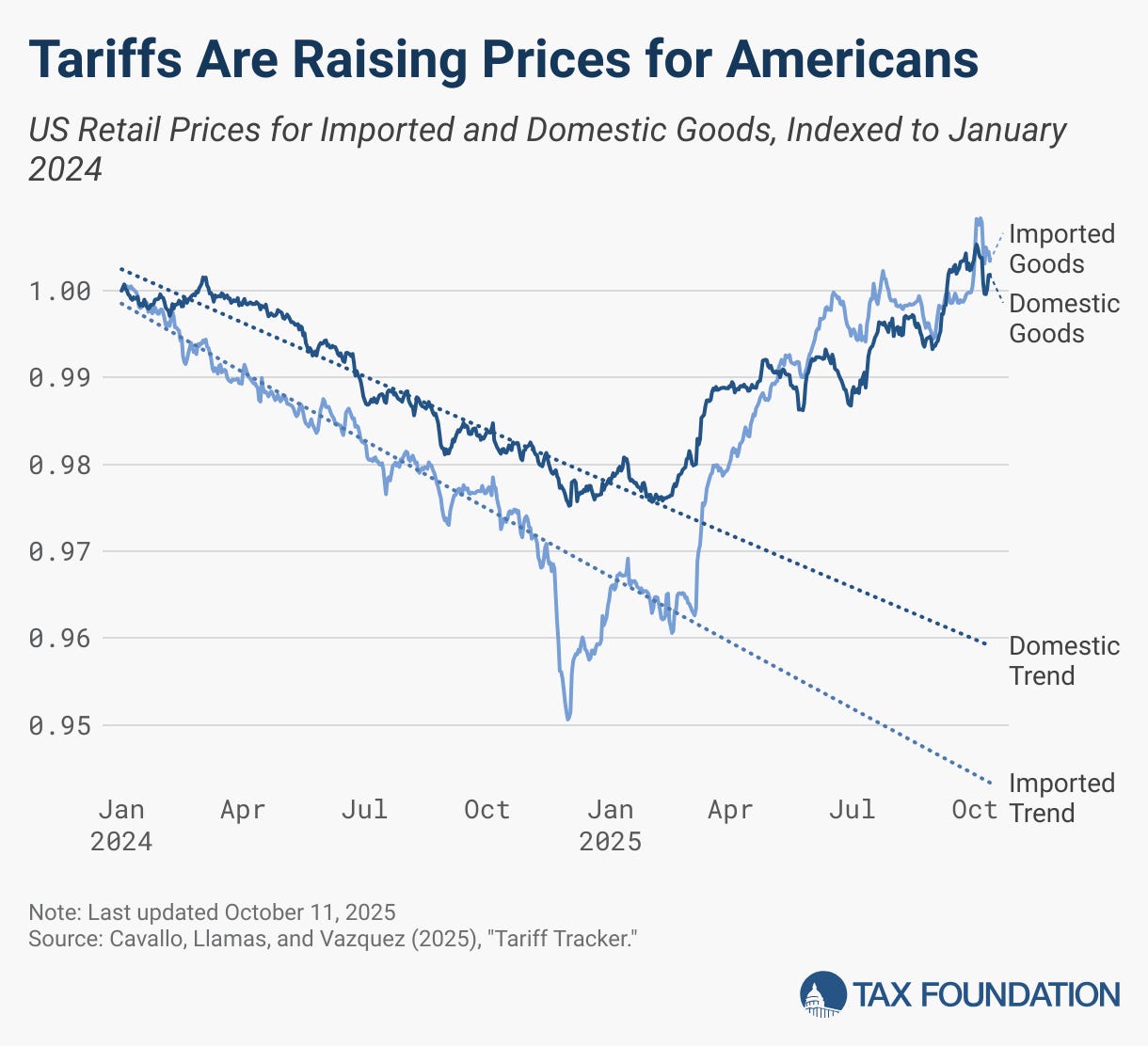
The numbers tell a simple story: America is paying more, investing less, and falling behind.
Unfortunately, it will only get worse. That is, unless the Administration tells the truth and ends this madness.
I won’t hold my breath.
This piece was co-written with Griffin Fill. Check out his Substack, The Diplomatic Pouch.
Nothing to disagree with here. Though Trump's policies are an often contradictory and random jumble of greed, nostalgia, whim, narcissism, grievance, and ethnocentrism (the latter a nice way to say "white supremacy").
Decades from now historians, economists, and political scientists will still be trying to find some common thread to Trumpism. Perhaps the best working explanation was offered by Ben Rhodes in a recent opinion piece in the NYT. Namely: "might makes right".
Yep. It’s just like that with the Fanta Fascist.
We have to change. If you want to see the change, you have to be the change. Feel free to copy and paste my list of demands. If we are loud enough together, maybe we can change the world.
My list of demands grows by the day:
Release the Epstein files. Abolish ICE. Bring back the tax rates of the 1950s. Overturn citizens united. Remove the cap on social security contributions, and make said tax also apply to capital gains. Universal healthcare, with no direct cost to the individual. Big pay increases for social workers, teachers, museum workers and librarians. Free childcare. Free university education. Forgive all student loans. 2 term limit for every political office. Mandatory retirement for politicians at age 70. Get rid of electronic voting machines. Eliminate the electoral college. Devise a standardized method of apportionment that eliminates gerrymandering.