


Liberalism has gone through many iterations.
In its long process of transformation, one of the biggest additions has been the concept of a “welfare state.”
The welfare state has a joint heritage, sharing its roots with both liberal and social democratic traditions. However, liberals and social democrats have always had different conceptions about exactly what is should look like.
Liberals have supported the welfare state for a wide variety of reasons. Some have viewed it as a pragmatic necessity for social stability. Others have made the case for it on the basis of freedom. Finally, some have accepted a more typical case for it on the basis of human well-being and positive social consequences.
Let me talk about each of these justifications in detail.
Social Stability
The case for the welfare state on the basis of social stability is largely pragmatic. It’s based on the descriptive observation that if people are left exposed to the ups and downs of a dynamic market economy, they are at high risk of abandoning liberalism and seeking solace in some alternative economic and social order. Thus, the welfare state is a concession to create a liberalism that can be sustained.
This is the argument provided by Samuel Hammond in his now well-known paper, THE FREE MARKET WELFARE STATE.
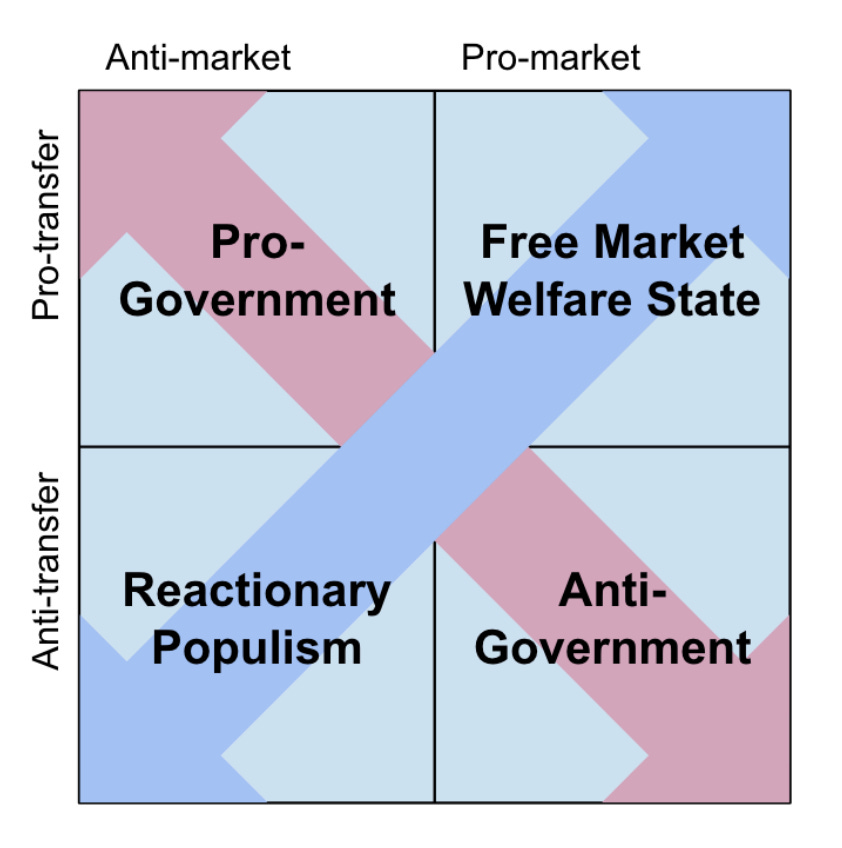
Samuel notes that while, at least in the United States, the debate has often been between people who are pro-market and anti-welfare and people who are anti-market and pro-welfare, in the real world, markets and welfare are actually positively related.
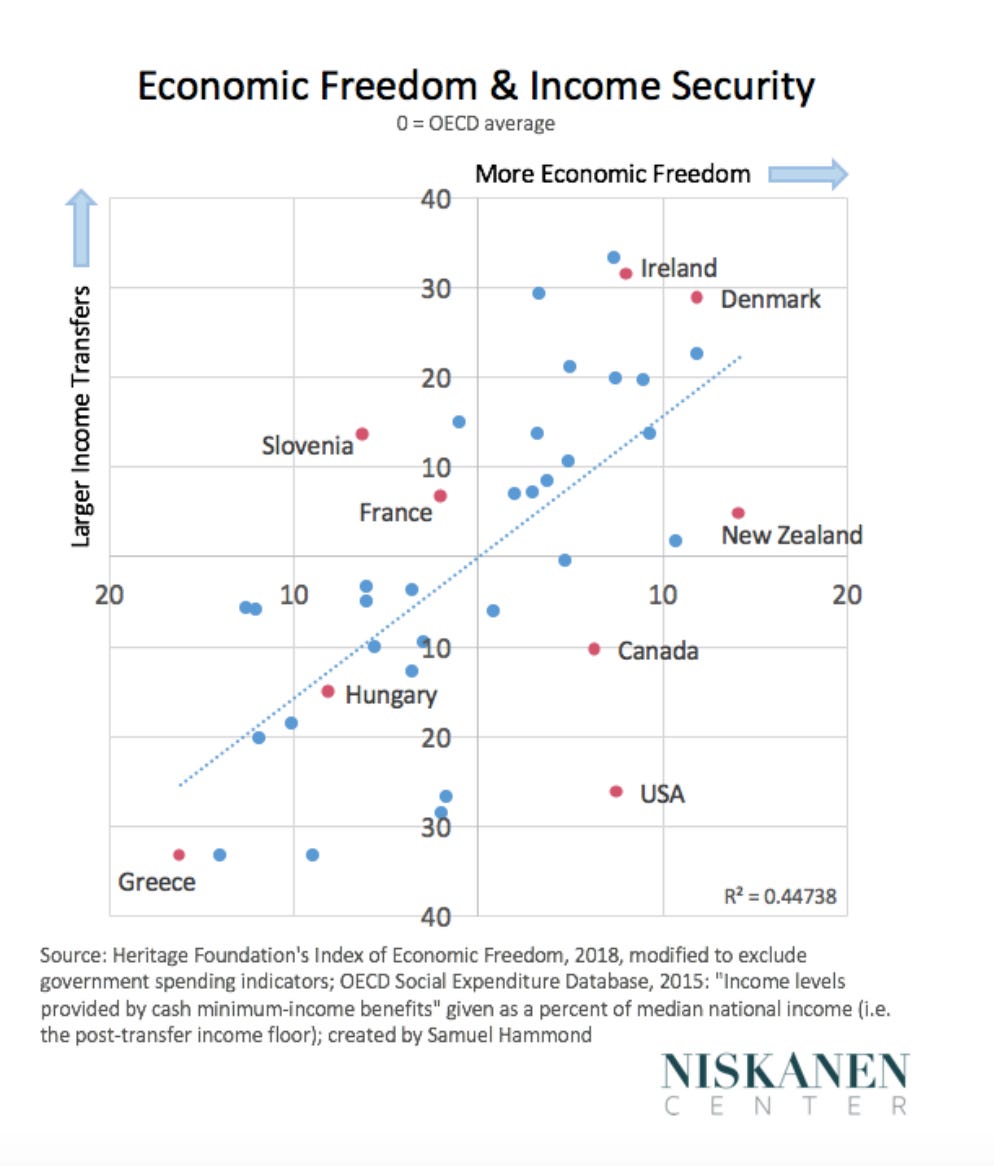
Countries that have higher degrees of income security due to the welfare state are able to have economies that are more innovative, dynamic, and disruptive because people are protected from the creative destruction of the market.
Meanwhile, countries that have less social spending on income security programs still attempt to achieve income security just through anti-market mechanisms, like regulations, protectionism, and draconian immigration controls.
Positive Freedom
Many liberals, especially those of the classical variety, have a view of freedom as fundamental freedom from coercion. In the eyes of these liberals, the sole political aim is the minimization of coercion, and thus, state action is only justified when it helps achieve this end.
Yet some have a different view on what the term means. These people termed social liberals, believe that freedom is not just about freedom of coercion but rather the ability to live the life that you wish.
In their eyes, the welfare state is justified on the basis that it enables more of the population to have control over their own destiny and choose their own fate. Social liberals note that financial resources can enhance people’s freedom by expanding the array of choices made available to oneself and opening doors that would otherwise be closed.
Social liberals view those stuck in a status of poverty as being fundamentally unfree. They note that the impoverished face an array of financial impediments that pose a particularly large barrier to the achievement of their will.
On this basis, social liberals argue that the welfare state is a powerful tool for promoting freedom. While they concede that redistribution necessarily reduces the financial resources of some to the benefit of others, they see the end result as an ultimately positive sum on the basis that economic barriers to the achievement of one's will are greatest for those with lower incomes and lowest for those with higher incomes.
Human Wellbeing
This is the argument that I find most appealing as a consequentialist.
It turns out that well-designed welfare programs can have a really positive impact on people’s lives. They can lift people out of poverty, improve their health and quality of life, and lower their likelihood of engaging in criminal activity. They can lead to a more equal distribution of income, which can strengthen the social fabric and lead to higher levels of utility (due to the falling marginal utility of consumption). They can also provide people extra income security, leading to their income being smoother throughout their lives, and thus, the financial stress that comes with large fluctuations in income being reduced.
Solid welfare programs can also have positive economic impacts. They can help people reach their fullest potential in the workforce by providing them the resources, training, and social security they need to pursue the career they are best suited for. They can encourage entrepreneurial risk-taking by lowering the stakes of failure. They can engage portions of the population that have low levels of employment, like mothers, the disabled, and those in impoverished communities.
I’m probably preaching to the quire here. But it’s important to note that one can be a liberal and value something other than Liberty. Some of the most famous Liberals in history, like John Stuart Mill, explicitly did so.
What differentiates Liberals in the political domain from other groups is the precise systems they support and the values that they are informed by. Liberals value openness, agency, choice, tolerance, cooperation, peace, and pragmatism, and that’s why they support a limited democratic government with a market economy. Modifications to the distribution of income could conflict with liberal values if it was achieved in a fashion that empowers state control over people’s lives. However, it could also be complementary to those liberal values and entirely compatible with liberal institutions.
So, there are the justifications. What do you think?
In a future piece, I’ll go over the difference between the characters of the liberal and social democratic welfare states. It is important to note that while they believe in one, they have pretty different ideas about what it should look like.
Until then, sayanora.
@Micah Erfan, nice piece. The issue is that, to the extent that we desire to use wealth distribution as a tool to enhance and uplift people, to maximize their innate potential, we have to tread carefully.
These problems require funding and there are limits to how much we can “tax” our way to this funding before we imperil the underlying growth.
If we stunt this growth through taxation or try to finance it through heavy debt burdens, we risk stifling prosperity, and when we do this, we return to a “zero-sum” world that can destroy democracy anyway.
This is one reason I have explored using vouchers for education and healthcare, coupled with spending caps, to try and balance these risks.
Why ARE your ARTICLE titles in ALL CAPS?