



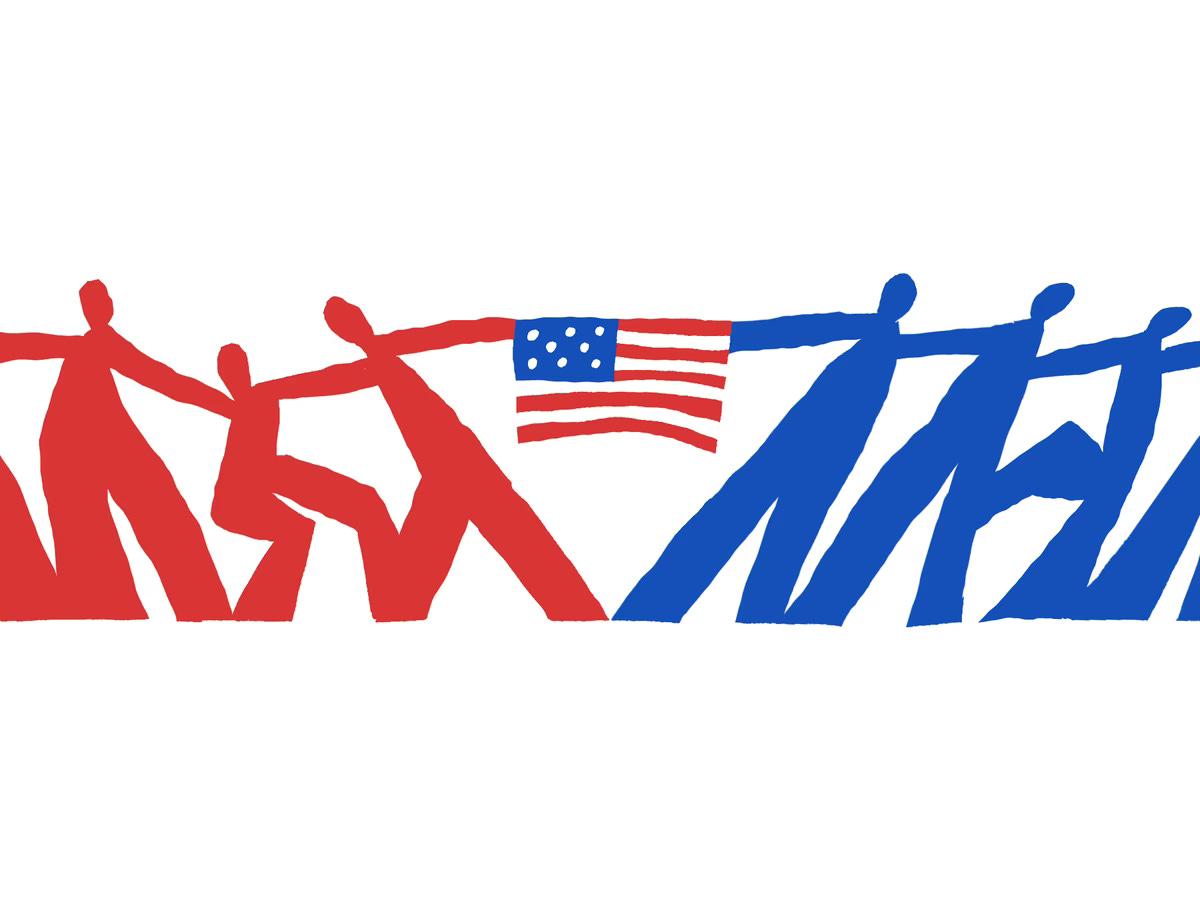
68% of American voters say they disliked both choices in the 2024 election. That number shocked no one. For decades, Americans have reported the same frustration. So the real question isn’t whether voters are unhappy. It’s how this keeps happening.
How is it that in a nation of 340 million people, we so rarely end up with candidates that most of us actually like? Why do our elections so often feel like a contest between the lesser of two evils, rather than a competition between the best available options? The answer lies upstream, in partisan primaries.
Under the current system, before the general election that everyone votes in, each party holds its own primary to decide who will represent it. These primaries effectively determine the choices available to voters in November. Yet only 20 to 25% of eligible voters participate in them. That small slice of the electorate is not representative of the public as a whole.
Primary voters tend to hold more extreme, ideological views than the broader population. As a result, the candidate most appealing to primary voters is often the least appealing to the general electorate. The consequences are predictable. Candidates are incentivized to represent not their district, but instead the small share of primary voters. This adverse incentive manifests in multiple ways.
First, partisan primaries tend to elevate hardline candidates who struggle with the general electorate. Recent examples include Kari Lake, Blake Masters, Doug Mastriano, Winsome Earle-Sears, all of whom won their primaries decisively, only to suffer clear losses in the general election. In each case, the race was winnable had the party nominated a more broadly appealing candidate.
Second, partisan primaries warp the behavior of candidates once in office. Elected officials are often forced to toe the party line and take positions that are unpopular with the broader public simply to avoid a primary challenge. Deviation from party orthodoxy is punished, even when it reflects the will of most voters.
A high-profile example is unfolding in Texas, where long-time Republican Senator John Cornyn now faces a serious primary challenge from Ken Paxton, a far more extreme Republican. In 2014, Cornyn opposed Ted Cruz’s move to shut down the government over Obamacare, and in 2022, he played a crucial role in the passage of the Bipartisan Safer Communities Act, a law aimed at preventing school shootings. Both positions were broadly popular with Texas voters. Yet those votes now threaten his political survival.
Cornyn is likely to lose to Paxton resoundingly in the primary, despite the fact that Paxton is far less popular with Texans, boasting only a 29% approval rating statewide. Future examples are likely coming in Indiana, where Republican state legislators who voted against Trump’s unpopular gerrymander push now risk defeat by Trump-endorsed primary challengers.
The pattern is unmistakable. Partisan primaries produce leaders who do not reflect the views of the public. They reward ideological purity over problem-solving and punish bipartisanship, even though bipartisan cooperation is essential in a country with divided government as often as ours. Instead of compromise, politicians are incentivized to engage in hyper-partisan posturing that generates attention but accomplishes little.
This institutional failure has consequences. Government policy swings wildly from administration to administration, rather than tracking public opinion, which makes far subtler, less extreme movements. Polarization only deepens as time goes on. And when neither party has a complete trifecta, policymaking comes to a stop.
Thankfully, the American people demand we cure this illness. Every poll in recent years has shown that most Americans don’t trust the government. In fact, an incredible 75% of Americans think that the government is actively working to favor itself and elites, not the country as a whole. Meanwhile, Americans in both parties actually agree on the government’s role and scope in many key issues. We find ourselves in a moment where the American people desperately want change, often agree on what that change needs to look like, but have no faith in the government as it stands today to enact that change. Radically altering our primary system is the best way to end this intolerable status quo.
So then, what would such a rethink of our primary system look like? The first step is to eliminate partisan primaries altogether and replace them with the all-party “jungle primaries” already employed in Alaska, California, and Washington. Under this system, every candidate for an office appears on the same primary ballot, regardless of party affiliation. Every voter participates in the same election. The top two, three, four, or five candidates then advance to the general election.
This reform directly addresses the core defect of partisan primaries: ideological gatekeeping by a small, unrepresentative electorate. Instead of appealing to the most partisan members of their own party, candidates must appeal to the electorate as a whole from the very beginning. The incentive structure shifts away from extremism and toward broad acceptability. Studies back this up and show reduced polarization, increased competition, and a greater likelihood that advancing candidates reflect the preferences of the median voter rather than party bases.
This sort of widespread reform of our primary system would not be unprecedented; after all, we have made big changes to our primaries before. Prior to the Progressive Era of the early 20th century, candidates were chosen by party elites in the “smoke-filled rooms.” Reformers pushed for an end to this undemocratic practice and began a march towards the present system. Gradually, the mid-20th century saw an expansion of primary elections across the country. It took a 1944 Supreme Court ruling to end white-only primaries in the South, and it was not until the 1970s that primaries existed in every state for presidential elections. So before anyone tries to tell you the primary system, as it stands, is some sacred and inviolable element of American democracy, remember that it’s barely 50 years old.
But all-party primaries alone are insufficient. In plurality voting elections, they suffer from a major flaw. Vote splitting. When multiple candidates appeal to similar constituencies, they can divide support and allow a less representative candidate to advance with only a small but cohesive base.
Consider California. Despite being overwhelmingly Democratic, there are scenarios where two Republicans could advance to the general election, simply because a crowded Democratic field splits the vote. A recent Emerson poll of the ongoing California gubernatorial race suggests this could even happen this year. Strategic withdrawals and tactical voting often prevent this outcome, but a well-designed democratic system should not rely on voter gamesmanship to avoid absurd results. That is why approval voting must accompany all-party primaries.
Under approval voting, voters may vote for as many candidates as they approve of. The top four or five most-approved candidates advance to the general election, and the most broadly approved candidate wins. Under an approval-voting, all-party system, the most popular candidate actually prevails. General elections are transformed from two-person lesser-of-two-evils contests into four or five-person greater-of-many-goods competitions. The political landscape would be fundamentally altered.
Demonizing the other side, currently an effective strategy, would become political suicide. Extreme positions that appeal to only 10 to 15% of voters would be abandoned in favor of policies that command broad agreement. The negative campaigns so popular at the moment would backfire, as attacking an opponent risks alienating voters who also approve of that candidate.
The politically optimal strategy would no longer be to please the primary electorate, but to reflect the actual views of constituents. The benefits go further. Third-party candidates and independents would finally have a viable path to victory if they could sway moderates. Long-entrenched incumbents in gerrymandered safe seats would face real competition. At present, over 85% of Congressional districts are uncompetitive; these reforms would help give voters a genuine choice.
The sickness at the heart of American politics, the polarization, the gridlock, the sense that nothing ever changes, is not an unsolvable cultural problem. It is an institutional one. And it can be fixed.
Subscribe to Griffin’s Substack, “The Diplomatic Pouch!”
What then happens to the electoral college? I’d like to see that go very far away.
I voted
Democratic since 1960 (JFK) . Wanted a fighter but rarely got one .Warren and Newsom types instead of Schumer and Co.
Raskin, AOC, Cdockett and Goldman are more to my liking.