



A while back, I shared a video snippet of some of my policy notes on healthcare.
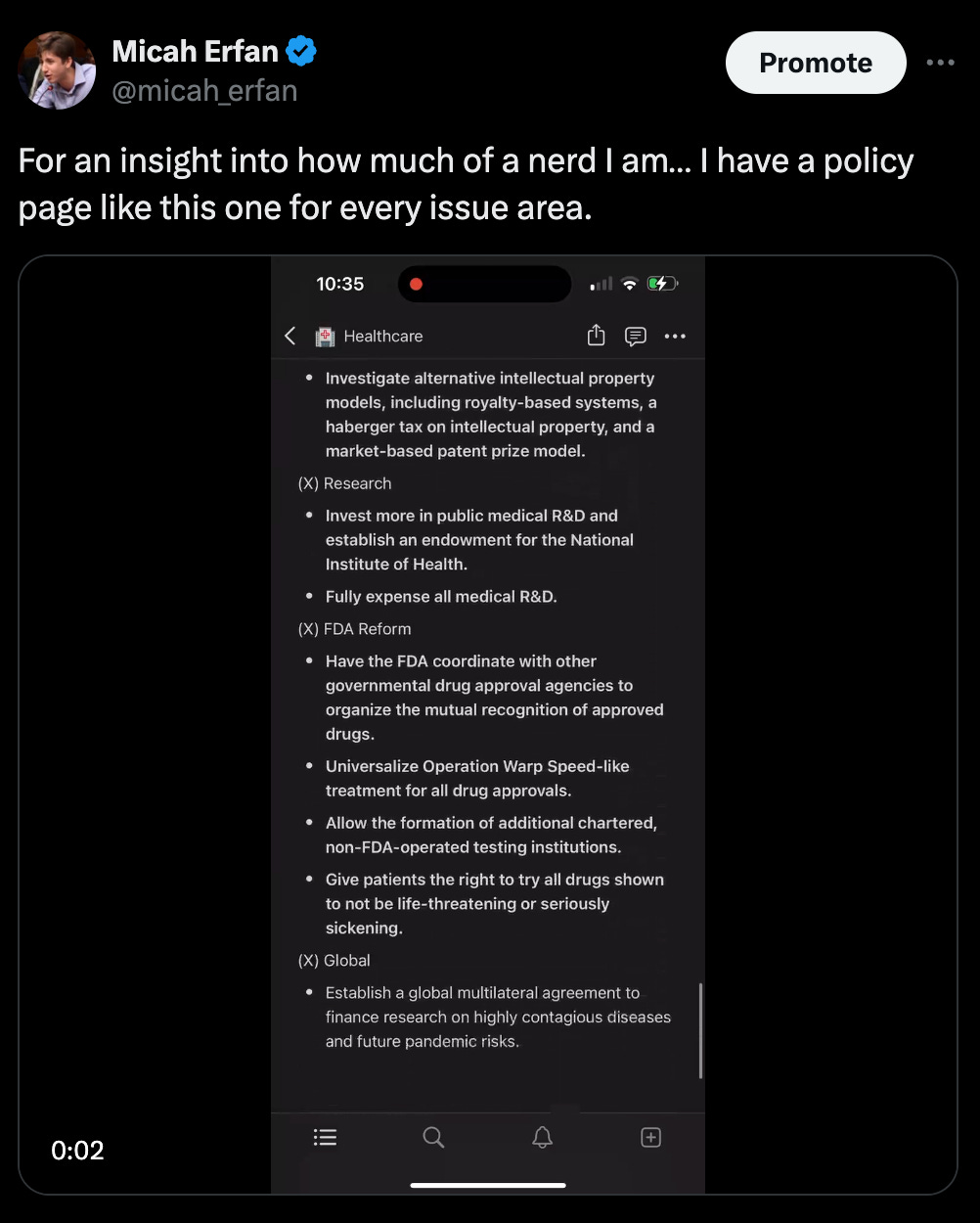
Quickly, I got many requests from people to share these notes, and so, by popular demand, I am finally getting around to doing so. Feel free to leave your questions and thoughts in the replies below. Warning: these notes are *pretty wonky*.
Giving Medicare to Everyone
(X) Universality
Auto enroll everyone, including the uninsured, those on the individual marketplace, public employee plans, Medicaid, the Child Health Insurance Program, and the group market into Medicare. Auto enroll Veterans Affairs and Tricare beneficiaries into Medicare as well and convert their existing plans into supplements.
Improving Traditional Medicare
(X) Coverage
Improve Traditional Medicare by adding coverage for drugs, dental, vision, and hearing. In addition, 0 out its premiums.
(X) Payment System
Provide capitated monthly payments for primary care services, similar to the direct primary care subscription-based model.
Embrace reference-based pricing for all shoppable services and products.
Example:
“Denmark has a comprehensive, single-payer health insurance system, financed by general taxation and administered at the regional level through block grants. However, Denmark does not regulate prescription drug prices. Instead, the Danish insurance system reimburses for any drug at the lowest price offered by a market participant for a given active pharmaceutical substance. Price transparency is universal; pharmacy prices are posted every two weeks by the Danish Medicines Agency (Lægemiddelstyrelsen). This encourages use of generic drugs. Consumers are free to pay out-of-pocket to use a costlier drug. However, since pharmaceutical companies would lose market share if their prices were too high, they have an incentive to price their products competitively. The Danish Ministry of Social Affairs and Health also has the latitude to choose not to reimburse for drugs in therapeutic areas with a monopoly supplier, though consumers are free to pay for these drugs out-of-pocket.“
Incorporate, where possible, value-based payment models for non-shoppable services.
End the defacto 6% commission for drug prescriptions caused by the A+6 formula.
(X) Cost Sharing
Eliminate deductibles and impose a $3000 out-of-pocket maximum.
Make preventative medicine and primary care free at the point of use.
For standard shoppable services, retain the current 20% coinsurance rate, with reduced coinsurance rates available for expensive procedures and for services/products relating to chronic conditions.
Utilize copayments for unshoppable services, including substantial copays for emergency room visits and hospital visits.
Improving Medicare Advantage
(X) Competition
Modify the risk adjustment model to take into account the unique cost implications that come from comorbidities.
Incorporate drug prescriptions and other services into the risk adjustment model.
Prohibit providers from charging different prices to different insurers for the same service.
(X) Consumer Help
Impose regulations on Medicare Advantage advertisements that prohibit unsupported claims and require all claims to be presented with data.
List all Medicare Advantage plans on healthcare.gov.
Lowering Prices
(X) Price Competition
Require providers to publish all prices publicly in a machine-readable file.
Strengthen anti-trust action to combat market consolidation among providers
(X) Price Regulation
Establish all-payer rate setting and central negotiation for ambulances and emergency care.
Impose federal price caps on monopoly medications (i.e., medication with no plausible alternatives).
Example:
“Holland has a universal system centered around private health insurance coverage. Prescription drug formularies are managed by the insurers under this competitive system. Coverage of some drugs is mandated by the Ministry of Health, which is advised on coverage decisions by the Netherlands Healthcare Institute (Zorginstituut Nederland). While drug prices float based on insurer-manufacturer negotiations, and insurers can increase or decrease deductibles for drugs based on their value, the government protects against monopoly drug pricing by setting price ceilings. Like Denmark and the U.S., generic drugs enjoy high market share in the Netherlands.”
Reducing Low-Value Care
(X) Bad Incentives
Ban referral-based compensation schemes for clinics and their employees.
(X) Defensive Medicine
Reform medical malpractice laws by capping non-economic damages.
Cutting Administrative Costs
(X) Nationalization
Establish a unified national all-payer claims database housed in a corporatized entity overseen by the Department of Health.
Explanation:
This creates a tremendous resource that can be used to better inform healthcare policy and private action by insurers and providers. Eliminates the need for private independent data gathering.
Study:
Create a central automated clearing house for all insurance claims.
Explanation:
Eliminates the complexity and costs associated with having multiple private clearing house intermediaries
(X) Standardization
Achieve national integration of electronic records by requiring mutual interoperability.
Explanation:
Eliminates the frictions caused by a lack of data sharing between different providers and insurers.
Make healthcare information more accessible to providers by centralizing all plan details into one easily searchable database.
Explanation:
Presently, it’s often unclear to providers what is covered by insurance and what is not, leading to complex back and forths, denials, and appeals. Strengthening minimum coverage standards and centralizing coverage information in a centrally accessible fashion will help minimize these costly frictions.
Expanding the Medical Workforce
(X) Secondary School
Support the launch of pre-med magnet and charter high schools.
(X) Medical School
Transition Medical School standard programs to a five-year program that starts directly after high school, with a four-year accelerated program available for undergraduate degree holders
Invest in substantial expansions in Medical School seats.
Make it easier for new Medical Schools to launch.
Require for-profit Medical Schools to abide by minimum admission standards and conditions and a set share of their payment on their graduates passing their medical licensure exam.
(X) Residency
Eliminate the legislative cap on Medicare-funded residencies.
(X) Other
Expand the scope of practice for nurse practitioners and physician assistants.
Provide an accelerated licensure program for immigrant doctors and nurses.
Establish a federal minimum licensure standard and require that medical professionals who are above that standard be legally allowed to practice in all states.
Expanding the Supply of Providers
(X) Regulatory
Eliminate all certificate of need laws.
Eliminate land use restrictions that constrain the supply of providers
(X) Taxation
Allow providers to expense all investment costs fully.
Promoting Innovation
(X) IP Reform
Crackdown on copycat drugs and patent trolls.
Investigate alternative intellectual property models, including royalty-based systems, a harberger tax on intellectual property, and a market-based patent prize model.
(X) Research
Invest more in public medical R&D and establish an endowment for the National Institute of Health.
Fully expense all medical R&D.
(X) FDA Reform
Have the FDA coordinate with other governmental drug approval agencies to organize the mutual recognition of approved drugs.
Universalize Operation Warp Speed-like treatment for all drug approvals.
Allow the formation of additional chartered, non-FDA-operated testing institutions.
Give patients the right to try all drugs shown to not be life-threatening or seriously sickening.
(X) Global
Establish a global multilateral agreement to finance research on highly contagious diseases and future pandemic risks.
My preliminary thoughts:
Questions
- Who comes up with the fraud prevention standards for the claims clearinghouse?
- Why centrally negotiate ambulance and emergency department prices instead of having the former be set by local bidding and the latter via negotiation/networks with insurers?
Revisions
- Replace diagnosis based risk adjustment with reinsurance
- Maintain demographic-based risk adjustment (if you want to keep community rating)
- Both financed by a fee on all Medicare plans
- I’d do a higher out of pocket maximum also
Possible Additions
- Default to longer-term insurance contracts
- Publish risk-adjusted mortality scores for each plan at point of purchase (could replace star system)
- Bundle life insurance
- End site-based billing (favors large hospitals at the expense of all other types of facilities)
- Shift FDA to just a safety standard (instead of safety and efficacy)
A thoughtful and reality based post.
A side issue not directly related to healthcare itself has been having an effect on healthcare administration. Hospitals and other institutions related to medicine seem to be hit disproportionately by ransomware and other cyber attacks. Is there something about such institutions which makes them more prone to such attacks? Such incidents can drive up costs and undermine confidence in the system.