

BREAKING: Republicans VOTE AGAINST Bill Ending Child Marriage in Wisconsin

Democrats introduced a bill to end child marriage in Wisconsin. Republicans have now let that bill die in committee, without a hearing, without a vote, without so much as a debate. It’s the same outcome they’ve reached every single time this bill has been introduced since 2019. Nearly 300 minors have been legally married in Wisconsin in the past decade while Republicans sat on the legislation that would have stopped it.
Wisconsin Democrats introduced legislation this session to ban child marriage in the state outright. Once again, Republicans who control the legislature have let the bill die in committee, refusing to give it a public hearing or bring it to a floor vote.
What the Bill Would Have Stopped
State Rep. Ann Roe of Janesville and Sen. Mark Spreitzer of Beloit, both Democrats, introduced legislation that would close a loophole allowing 16- and 17-year-olds to marry in Wisconsin with nothing more than written parental permission submitted to a county clerk. No court oversight. No minimum age gap requirement. Just a parent’s signature next to a standard marriage license.
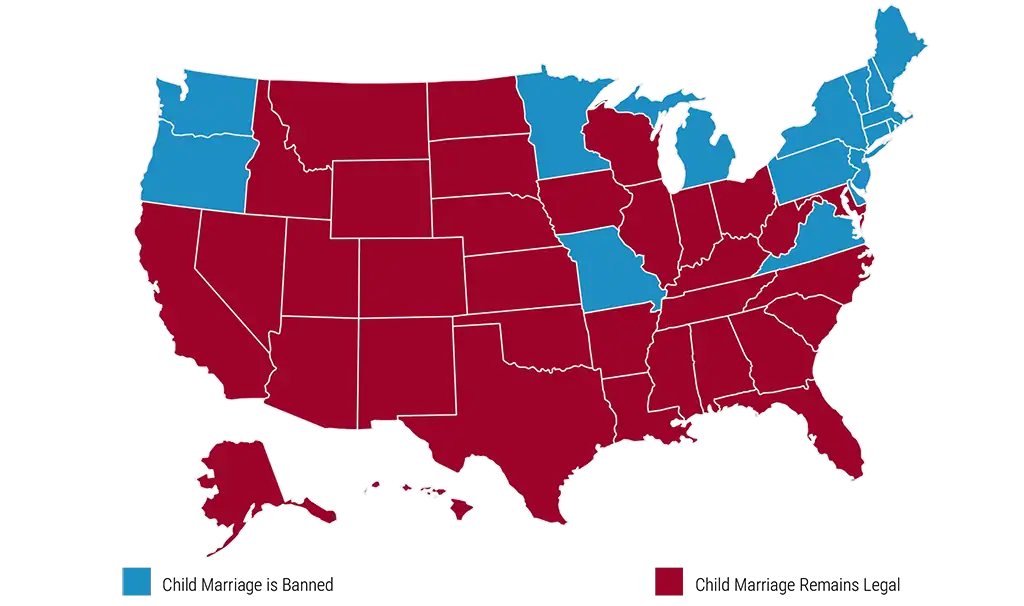
The bill would have brought Wisconsin in line with a growing list of states that have banned marriage under 18 with no exceptions.
Instead, the legislation followed the same path it has taken every time Democrats have introduced it since 2019: straight into a Republican-controlled committee, where it sat without a hearing until the session ran out.

The True Stakes
Between 2015 and 2024, 297 minors were married in Wisconsin, according to the nonpartisan Legislative Reference Bureau. In 2024 alone, 27 minors were married, 8 of them just 16 years old.
These aren’t teenagers marrying other teenagers. From 2017 through 2019, every single minor married in Wisconsin married an adult. Between 2010 and 2022, the overwhelming majority of underage marriages in the state were to adult spouses.
And Wisconsin law doesn’t just permit this. It protects what happens afterward. State law carves out an exception to its own statutory rape statute: sexual contact between an adult and a minor is not a crime in Wisconsin as long as the two are married. Outside of marriage, that same conduct is a felony.
“These are marriages between a minor woman and an older man,” Roe said. “The behavior outside of marriage would be a felony... Using this old law that’s still on the books that allows for child marriage is incredibly disturbing and incredibly dangerous for young women.”
Republicans’ Justification
Republican legislative leadership, which controls what gets a hearing, has defended killing the bill by arguing that current law respects the rights of parents to make decisions for their children.
That explanation doesn’t address why a parent’s signature should be able to override a statutory rape law, or why a legal framework written in 1849 is still being used in 2026 to let adults marry children.
Wisconsin Is Now Behind Even Deep-Red States
The contrast is getting harder for Wisconsin Republicans to explain away. Seventeen states have now banned child marriage entirely, starting with Delaware and New Jersey in 2018 and expanding to include Minnesota and Michigan.
Last month, Oklahoma, a state with full Republican control of its government, became the 17th state to ban the practice. “Oklahoma has a responsibility to protect children and make sure they have the opportunity to reach adulthood before making decisions that will shape the rest of their lives,” Republican state Rep. Nicole Miller said when that ban passed.
Wisconsin Republicans have now fallen behind not just Democratic-led states, but Republican-led ones too.
The Bottom Line
Democrats brought a bill to end child marriage in Wisconsin. Republicans let it die in committee without a hearing, the same result this legislation has gotten every time it’s been introduced since 2019. Nearly 300 minors have been married in Wisconsin over the past decade, most of them girls marrying adult men, protected by a statutory rape exemption that only Republican inaction keeps on the books. Whether that changes will depend on who controls the legislature after the November election.