


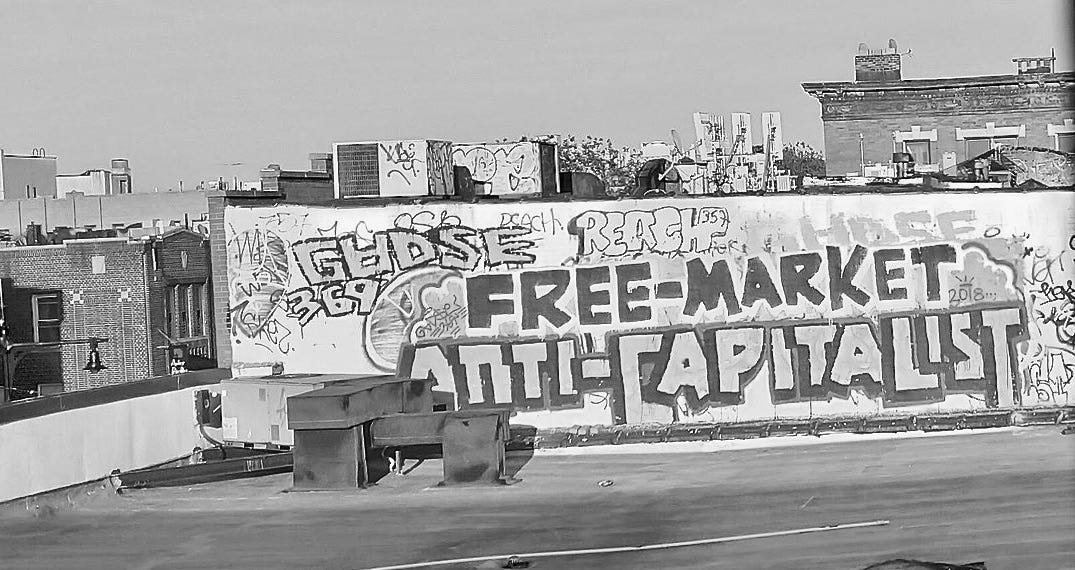
Capitalism isn’t very sexy, but markets are. The idea that the economy can consist of a diverse array of free, independent participants acting to satisfy our diverse wants and needs is quite appealing to many. All the more so when the posed alternatives like Decentralized planning (ex: PARECON) and Central planning are obviously atrocious.
What’s less appealing is the idea of a concentrated wealthy class sitting at the top of this system. Particularly one that can accrue their wealth without doing much and then pass it on dynastically. It’s certainly not an ideal dynamic, which has led many to ponder alternatives.
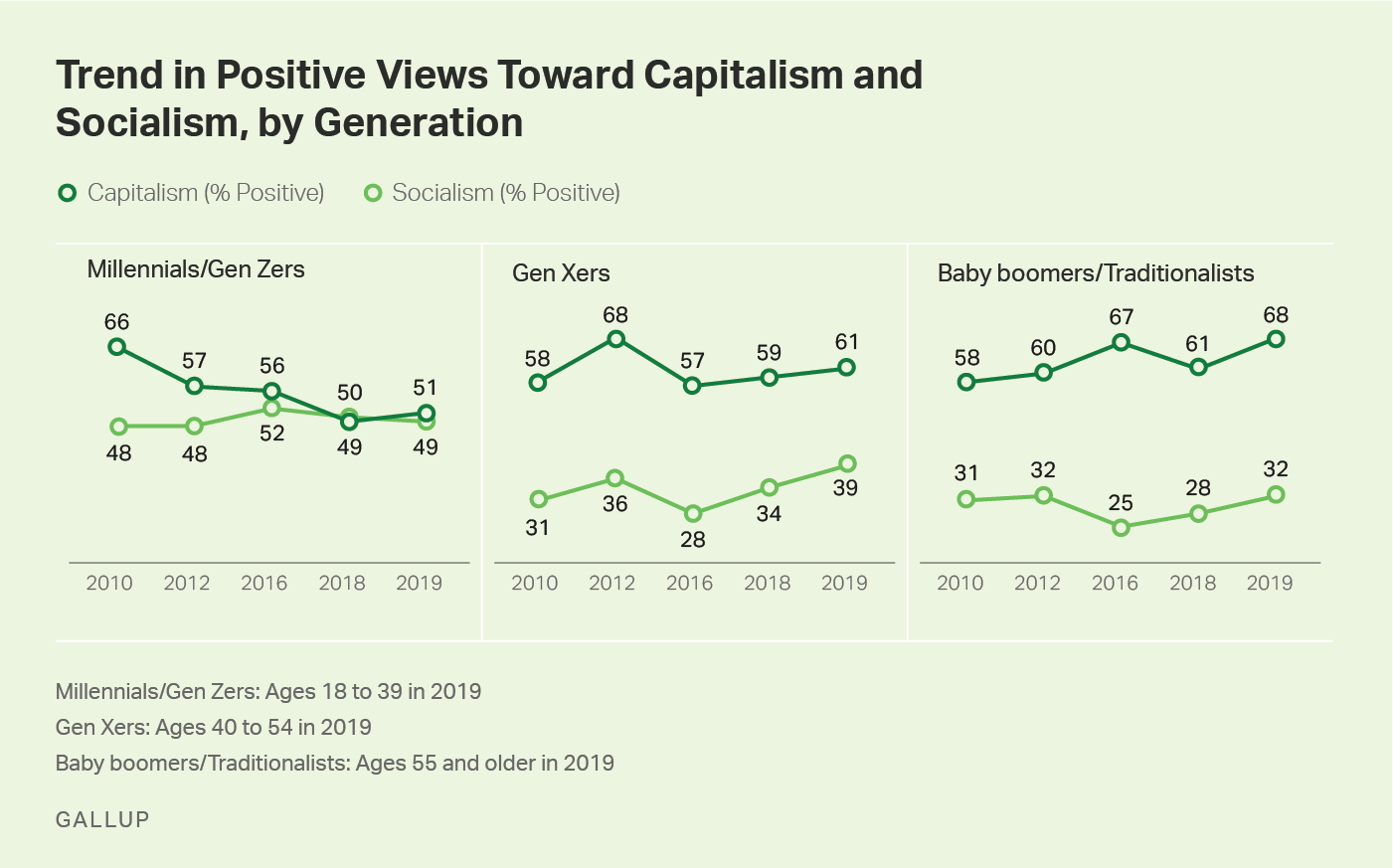
What if, these individuals ask, we were able to marry social ownership with markets? In other words, what if we could have the best of both Capitalism and Socialism?
For a long time, this was a view I found quite appealing. But upon the review of the many market socialist models that have been devised thus far, I have found them consistently disappointing. While it may be possible to devise a system that systematically hybridizes both social ownership and markets, it’s unlikely you get the best of both worlds.
Rather, as I will reveal, you often get a bastardized monstrosity, dysfunctional even under its own assumptions, and even more so if attempted to be applied within the confines of the world as it actually exists.
Cooperatives hurray
There are many models of Market Socialism, but by far, the most prominent have been those that fixate on near-universalizing worker-owned firms.
The idea is quite straightforward. Capitalists are not only bad because they take so much money but also because they organize workplaces in a way that is alienating and possibly even inefficient. Thus, worker ownership is the natural resolution to these contradictions. It allows the market mechanism to stay intact, reduces inequality, and fulfills the long-held dream of making workers their own bosses.
Allocative Issues
The central feature of Worker-Cooperative Centric Socialism is tying capital and labor together. In a typical Capitalist economy, capital flows to its most profitable use, and labor does as well. The places that can provide the highest rate of return get the most investment, and the jobs that pay the most at a given level of intensity get the most applicants. This process ensures that, at least at a fundamental level, there is an efficient allocation of the factors of production (although, to varying degrees, market failures impede that).
In Co-op Socialism, this is no longer naturally the case. Now, firms must take capital and labor together, even if they only want one. Firms that can generate the highest return on capital get less capital because they may not be able to generate a very high return on more labor, and vice versa. Small enterprises are harmed the most. They, unlike larger firms, are less credit-worthy and thus will be even more capital constrained than their larger peers. The effect is a reduction in the aggregate level of capital formulation and a less well-ordered distribution of investment among firms.
Transaction Costs and Valuation
Allocation isn't the only source of inefficiency. Since workers must buy into firms upon joining them (so as to become equal shareholders), every hiring and firing becomes not just a negotiation of wages but also of company value. In order to ensure they don't get duped, prospective employees will need to do their due diligence about how much the company's capital is worth. Unfortunately, in this process, they will be impeded by a severe lack of information.
In Capitalism, ascertaining the value of many firms is quite easy since 1,000s of actors at all times are usually trading shares of the company, providing abundant information aggregation. Even in the cases where companies are privately listed, investments are made by large financial actors who have the time and expertise to get a good understanding of the business’s value.
Under Co-operativism, on the other hand, there is only one poorly equipped buyer and one seller at the negotiation table, and in the case of a worker leaving a co-op, they don't even have the option to leave that table.
This leads to a more costly hiring and firing process and produces inaccurate valuations. Given that valuations will differ more from their actual worth, some firms will get even less investment than they deserve, and others will get more. Workers transferring jobs will be the biggest victims. Co-ops will be strongly incentivized to oversell their company’s value on the front end and undervalue the company at the back end. Fired workers may fall victim to prejudiced valuations and will have little legal recourse.
Many workers also won't have enough money to buy into a firm in the first place, maybe because their previous firm failed, they spent all their savings, or the firm they are joining is far more capital-intensive than the previous one they worked at. For instance, if Apple was a co-op, every new member would need to pay over 400k to join it.
Co-ops will certainly attempt to get around this by providing workers credit that they can pay back over time, but in effect, this will leave some members saddled with enormous monthly payments for years.
Internal Capital Accounts
One way the previously mentioned issues could be partially ameliorated is to allow differing degrees of ownership among workers by using uncapped internal capital accounts. Under this model, collective ownership would be abandoned in favor of a strange hybrid. Different workers would have different claims to the company’s net worth, but they wouldn't have different levels of control over company decisions.
This produces a contradiction. If the return on capital accounts is determined by revenue minus expenses, then it is entirely in the interest of workers who have less than the average amount of capital to support wage increases. Wage increases effectively take some of the profit that would have gone to the invested workers and gives that money to the ones who have invested less.
Now the rate of return on internal investment is entirely determined by democracy and not markets. It will generally be in the interest of most workers to depress the return on investment for their own short-term gains. Workers that do save will now be subjected to the same potential losses, but smaller upsides than they would before, and thus less internal investment will occur, harming growth.
Under Capitalism, the capacity for such games within worker cooperatives is limited since workers can now invest in firms external to the one they work at, forcing co-ops to be more disciplined in their rate of return. This is obviously no longer the case in Market Socialism, where workers only can invest in the firm they work at.
An alternative some co-ops have employed is paying a fixed interest rate on the capital allocated; this avoids the problematic contradiction in incentives but reduces the capacity for the firm to get capital. Credit is riskier than equity, and so if a firm is fully reliant on credit, it will be less able to raise money and more likely to go under.
In addition, under this model, since all capital income (minus effective interest payments) is divided among workers evenly, there is a greater risk of lower-productivity workers having their compensation raised above their actual contribution.
Every new employee brought on defacto dilutes current workers by taking a share of the pie. This is because, even though technically, there isn't much in the way of equity anymore, in practice, there is. It's just that this equity can't be bought or sold; its value is only appropriated by the present workers. Workers that enter the firm will get a share of the proceeds, and these wages will likely be higher than the actual value of their actual contribution. Workers are automatically partially expropriated with new entrants, and this makes it harder for them to justify expanding employment.
Structural Unemployment
The previous sections dealt with the issues workers joining and leaving co-ops would have and how capital accounts don't solve these problems. But in fact, the workers granted such an option are lucky. Mandating worker ownership will render many without the luxury of being able to get a job in the first place.
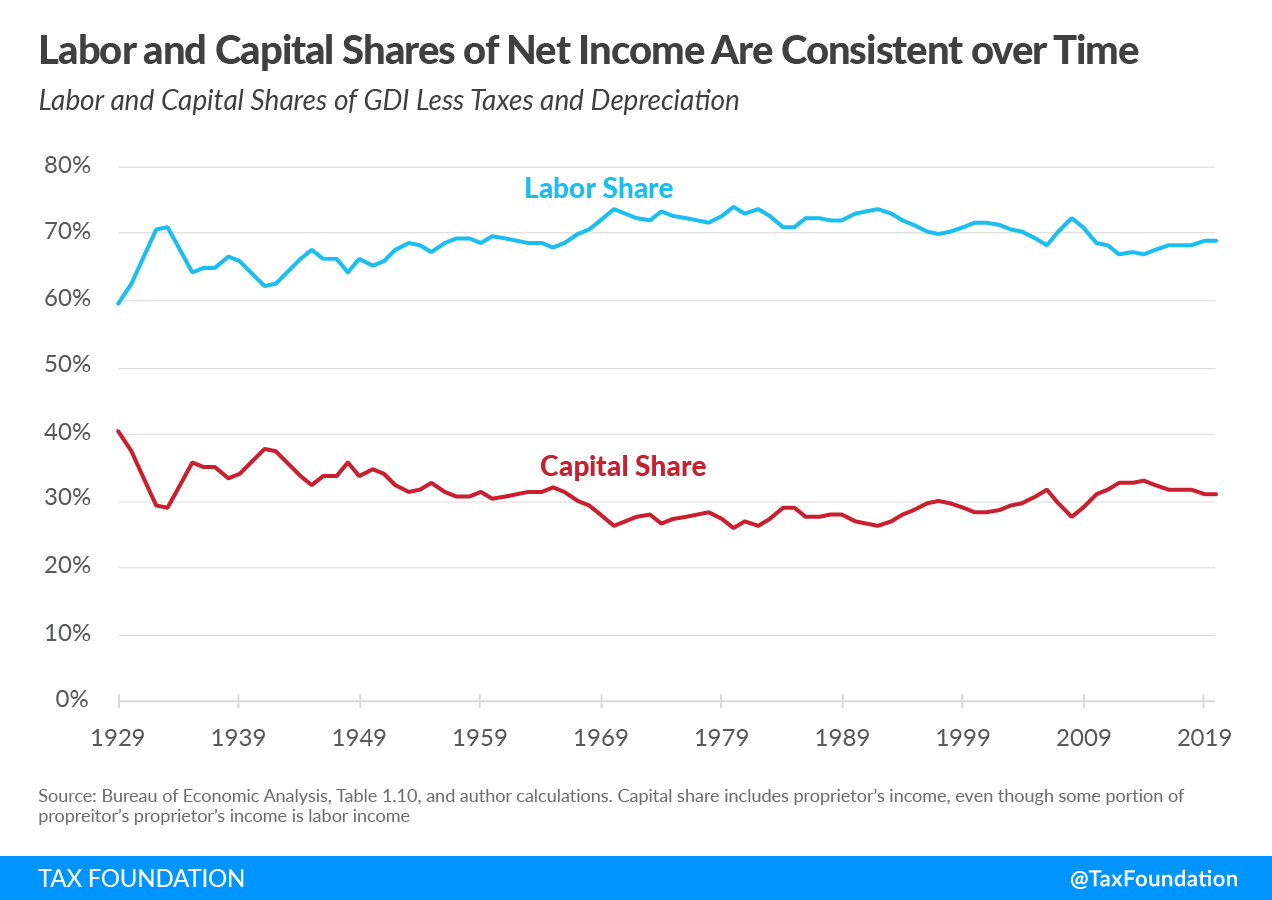
Under Capitalism, firms have the incentive to hire as many people as they possibly can make a profit off of. It doesn't matter if the expected surplus is 100 dollars or 10,000 dollars; there is an incentive to do so. The division between labor and capital rents is naturally determined by the market. Employers in labor markets are forced to compete over workers, only keeping the money they get after paying all expenses (including wages). Over time this has led to a pretty consistent capital rent share of around 30% of GDP.
In worker-owned firms, the separation between returns from labor and capital is impossible to discern. Pay is no longer set by the market (productivity); rather, it is set by the firm's internal politics. Most co-op members will find it in their interest to vote to reduce the wages of those above them and use that money to increase base-level pay.
The capacity for higher-skill workers to resist this by leaving will be significantly diminished by the previously mentioned reductions in labor market mobility, the threat of losing much of their capital value upon ejection, and the collective ethos that is embodied in the firm’s structure.
This is confirmed in the data. A study on how the compensation structure of Uruguayan worker-managed firms compared to capitalist firms found the following:
“First, WMFs exhibit a more compressed compensation structure than conventional firms… This result is consistent with the hypothesis that workplace democracy is associated with substantial redistribution among workers.”
“Second, WMFs suffer from brain drain: the separation hazard of highability members is more than three times higher than that of low-ability members. Moreover, I find that there is a relationship between the extent of pay compression and the severity of brain drain in WMFs"
“Finally, I find that… high-wage workers (employed at a WMF in 2009) who switch to the capitalist sector experience a gain in their wages upon quitting.”
As the results indicate, pay will be far more compressed and thereby less related to market conditions. Bottom-end jobs that provide a low marginal product will end up demanding compensation more than their worth. The result? Many jobs that would be profitable to create under Capitalism would not be profitable under Market Socialism.
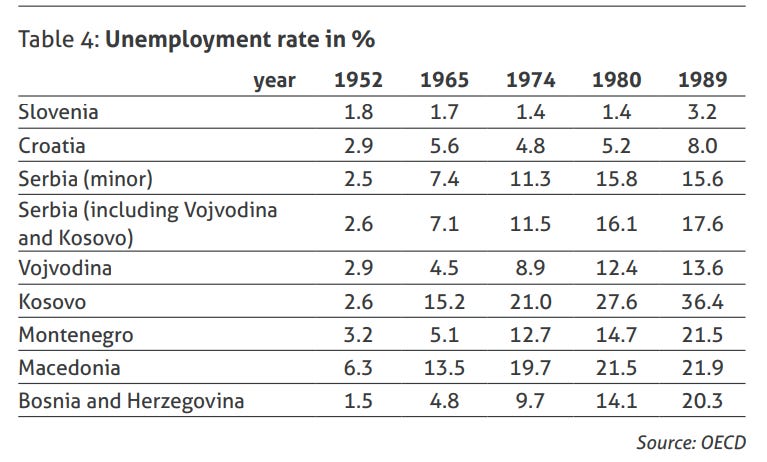
This is one of the key reasons why Market Socialism in Yugoslavia struggled so much with unemployment. Even prominent market socialist David Schweikart admits unemployment may be a problem and thus proposes guaranteeing everyone who can't get a job in a co-op a government job.
In the current economic system, large co-ops have bypassed this constraint by creating a new tier of non-member contract workers. In the case of Mondragon, this figure consists of roughly 30% of the workforce. While this is quite helpful for profitable employment expansions, it also boils down to an effective reinstatement of capitalist property relations with a large section of the workforce.
Already under Capitalism, getting full employment requires solid regulatory and monetary policy. Co-operativism introduces a new problem, even if the rest of public policy is completely perfect, a large percentage of the workforce will be left jobless.
Diversification
Any financially literate person knows the golden rule of minimizing risk, diversification, diversification, diversification. Yet it appears co-operativism forces the opposite to take place. Not only are nearly all of your savings centralized in one firm, but also, that firm just so happens to be the place you work. So, if your firm goes bust, you lose both your job and your retirement.
Equality
Some may think all the aforementioned costs may be worth it for enormous gains in equality, but unfortunately, these gains are hard to find. Firms differ wildly in how much capital they have and how much profit they make per worker. Air Lease, an airplane leasing company, makes a whopping 4.3 million dollars per worker. On the other hand, Starbucks only makes 84,947 dollars of revenue per employee, and only a small fraction of that is profits.
Worker ownership of all firms would not eliminate massive inequalities in capital income. The only way to solve this problem is through state ownership of all capital and the leasing of that capital to workers, but this doesn't sound very much like a market anymore, now does it?
The models can't save you now
The Co-op Socialist models that exist usually attempt to address these structural deficiencies, but often they do so by trading one problem for another.
Yanis Varoufakis's Corpo Syndicalism attempts to sidestep the transaction cost problem by embracing internal capital accounts, but this, as mentioned earlier, worsens inequality problems and increases capital constraints.
David Schweikart's Economic Democracy tries to fix these problems by providing investments in the form of government grants financed by a tax on capital assets, but this does no such thing. Doing so effectively subsidizes intangibles (like human capital) and gives the state a dangerous monopoly on capital allocation. It also retains the employment problems and introduces a nightmarish valuation dilemma (all capital assets must be valued every single year).
The Ilyerian model used in Yugoslavia, similar to Economic Democracy, problematically gives the state a monopoly on capital allocation and establishes additional distortionary government interventions in firm management.
Dreams of worker democracy have deluded too many people into holding an untenable position. A Co-op mandate would sabotage growth and reduce prosperity while leaving inter-firm inequality fully intact. High-productivity workers would have their wages garnished by those that work less hard. New entrants would be locked out due to capital constraints. Millions would be left jobless, and workers who belong to failing firms would have their life savings eviscerated.
Socialism would be had but at the cost of nearly everything else.
We can create a world that is far more equal, just, and prosperous, but Worker Co-op Socialism is not the way to do it.

Future parts of this series will be dedicated to addressing alternative models of Market Socialism, such as Shareholder Socialism, Economic Pluralism, and the Lange Model. Until then, Adieu!
Very well thought out and presented!
I would just add that the words capitalism and socialism are both toxic – for different reasons. They need to be scuttled with nouns/descriptions which are 21st century and don't carry the heavy luggage associated with those 19th century terms.
Certainly fails to achieve the workplace democracy aspect that is so tempting about market socialism, but I wonder if this makes for a decent argument for a truly enormous SWF + UBI as an alternative. Rather than trying to make every worker a partial owner of the firm they work in, just make the public a substantial stakeholder in the *entire economy.* It isn't socialism, but it is something.