


I’m not gonna pull any punches, folks; a lot of things in this country suck.
Here is a list of ways from a recent article of mine, The FUNDAMENTAL PROBLEM and how we SOLVE IT:
Economic growth is slow, real wages are being squeezed by a crisis of affordability, and too many are left in a state where they struggle to make ends meet or, even worse, fall prey to poverty and homelessness.
Our healthcare system is failing to provide everyone with affordable and timely access to the care they need.
Our education system is falling short of equipping the next generation with the skills and knowledge they need to be productive members of society in the 21st Century.
Mass incarceration is leading to incredible amounts of suffering while failing to keep our communities safe.
People are punished by the state for doing the things they want, even when those things don’t harm anyone else.
A debt crisis is looming in our future, fueled by endless deficit spending over decades and unfavorable demographic trends.
Car centricism has leveled our cities and put 100s of millions of Americans in cities that, by all accounts, are unwalkable and bad for their physical and emotional health.
Greenhouse gas emissions are driving forward a climate crisis that will have devastating consequences for the human race.
Our authoritarian foes around the world are emboldened and now capitalizing on our weakness to attack their neighbors and expand their power.
Pretty bleak stuff.
In part because things suck so much, folks are increasingly looking for answers. They are shopping on the ideological marketplace, trying to find a political worldview that succinctly explains the source of our problems and also provides convincing solutions to them.
Here is the bad news: the bad ideas are winning right now. Populists on the right and on the left have largely been selling people their recycled basket of super lame non-solutions. On the right, it’s deportations, protectionism, and isolationism; on the left, it’s inefficient tax hikes to pay for highly inefficient social spending with a nice side of inefficient regulations, inefficient labor policies, and also inefficient state ownership.
Suffice it to say these ideas, like most ideas that emerge out of a simplistic US vs THEM, zero-sum view of the world, aren’t great. That’s usually where the liberal analysis stops, but NOT THIS BLOG; hell no!
It’s not enough to show that populist ideas are often bad; liberals need to start putting forward their own positive forward-looking agenda, if they want to have any hope of beating out the bad guys on the ideological marketplace, and also, most importantly, if they want to actually have a chance of solving society’s problems.
So that’s what I’ve done right here in the handy dandy blog post. Here is a taste of BIG policy solutions I’ve come up with to solve some of our economic problems, built on the eleven liberal values I detailed in LIBERAL'S 11 core BELIEFS:
#1 The Abundance Agenda
As Noah Smith has aptly put it, America has become a “Build Nothing Country.” We have strangled our own economy in proceduralism, red tape, and bureaucracy, and we are paying the price, literally. When you make it more costly and sometimes even illegal to engage in productive activity, things become more expensive, and high-paying job opportunities are stripped away from the population. It’s a lose-lose, and it’s happening all over the place.
So here is the first big plank of a bold liberal agenda built on the value of Economic Freedom: let’s have an Abundance Agenda.
Let’s roll back counterproductive zoning and land use regulations so we can build more housing where people want to live.
Let’s reform the permitting process and the energy regulatory scheme to speed up the clean energy transition.
Let’s overhaul occupational licensing laws, expand the scope of practice for nurses, end certificate of need laws, and reform the FDA to bring down healthcare costs and increase the rate of medical innovation.
Let’s reform the tax code so that less of the tax burden is on socially helpful, economically enhancing activity (like investment) and more of it is on rent-seeking, unhelpful activity (land speculation).
I think you are getting the gist by now; just via a smart, evidence-based overhaul of the regulatory state and pro-growth tax policy, we can make Americans' pocketbooks way better off and help solve issues like climate change and homelessness, all without tax hikes, spending cuts, or more borrowing.
#2 Free Trade
Despite what the America First Protectionists tell you, free trade is, in fact, very good.
It allows countries to specialize in doing what they are best at and never fails to raise real (inflation-adjusted) wages and increase the rate of economic growth. That’s why it’s so surprising that we haven’t struck more free trade deals by now.
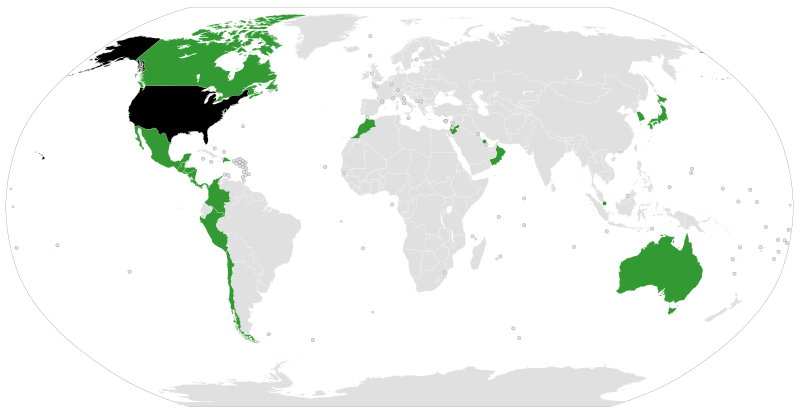
0 free trade deal with Europe is ridiculous! The American government is leaving 100s of billions if not trillions of dollars, of economic activity on the table by not lowering these trade barriers.
Furthermore, part of this move should also include quasi-protectionist policies like unfair subsidies to domestic industries via buy America requirements, corporate welfare, and the horrid Jones and Dredge Acts.
Want to “end inflation” like the orange guy, MR. DJT keeps talking about? Do the opposite of what he says and embrace free trade.
#3 More Legal Immigration
Our population is aging, and that means more people are going into Social Security and Medicare, and there are fewer workers to support them. That’s putting our national debt in an extra worrisome spot.
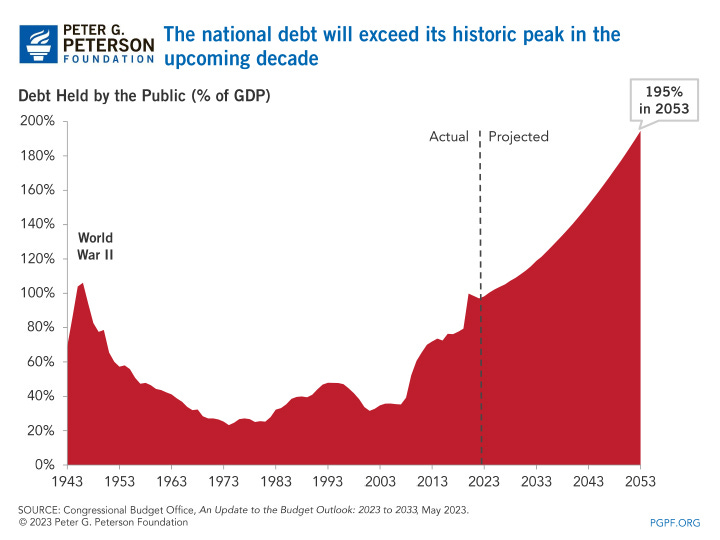
Ignoring the looney toons' ideas of MMTers, we are generally presented with two choices: either cut spending or raise taxes. But there is a secret third option: work-based immigration.
America’s superpower historically has been welcoming the best and brightest from all corners of the globe to come to our country and providing them the liberty and economic opportunity to do really cool shit.
Unfortunately, right now, we are blocking a lot of these incredibly talented and skilled folks from coming into our country because of arbitrary work-based immigration caps and visa caps.
Here is a simple solution: abolish the caps. If someone is able to demonstrate sufficient skill and meets basic criteria like not being a criminal, they should be able to come here. Not only is this demonstrably good for their quality of life, but it’s also incredibly for America.
Out of all policies, this would likely be the most pro-growth, and if done with sufficient ambition, it could seriously ameliorate our deficit issues without requiring a dime of tax hikes or spending cuts.
#4 Streamlined Welfare
Our welfare system is not very good at its job. Depending on how you count welfare programs, we have anywhere from 60 to over 100 federal programs. That’s a lot.
But we still managed to have heaps and heaps of poverty, in part because benefits are not comprehensive, in part because many low-income folks never get the benefits they are eligible for, in part because the system is mired in welfare cliffs and poor incentives, and in part because a solid portion of the money we are spending is burned up in administrative expenses.
So here is an idea: let’s streamline the welfare system. Instead of dozens and dozens of tiny, ineffective programs, let’s do a few big, comprehensive, evidence-based ones.
I’m thinking of something like a big Housing First program to get all homeless people off the streets, a universal child allowance/child tax credit to eliminate childhood poverty, a basic income/negative income tax to eliminate adult poverty, a disability benefit, and boosted unemployment insurance.
With this highly streamlined array of benefits and the new focus on enhancing people’s individual choice and autonomy (liberal values), we should also consider copying Estonia and auto-enrolling people in benefits they are eligible for so no one falls through the cracks.
With just the money we are spending today, we could probably wipe poverty out or at least cut it by a lot.
#5 Medicare for Everyone
Like many other sectors of America, healthcare is in a rough spot. Our insurance system is fragmented and byzantine. Competition is often hardly present. Coverage isn’t universal. Everything is crazy expensive.
The previously mentioned Abundance Agenda will help with some of this stuff, and so will other nerdy ideas like requiring price transparency for healthcare providers, reforming intellectual property laws for drugs and devices, improving data sharing, and so on.
However, there is a big ticket item that I think liberals have a unique opportunity to address in an appealing way: What is the best way to achieve universal health insurance?
Progressives have a clear plan: Medicare for All. What is it? Giving comprehensive government health insurance to all people paid for by taxes, with no premiums, deductibles, or copays.
Interestingly enough, this plan has little in common with its namesake, Medicare. Currently, existing real-world Medicare is not a single-payer system; it is a managed competition system. People in the Medicare system are given a choice: choose between the government's Traditional Medicare plan or an array of private Medicare Advantage plans. Right now, just over half choose the latter.
Far from being a Single-Payer system, the current Medicare model is more akin to the Managed Competition healthcare model used in some of our OECD peers, where coverage is universal, but people have a choice over what plan they prefer.

This is preferable to single-payer because people aren’t trapped in a government plan. That’s actually super important because the government plan has a very high probability of being bad.
Look no further than Canada, where the government-funded healthcare system is plagued with crazy wait times because of underfunding. In the Medicare for Everyone system, I propose in the case that the government Medicare plan sucked, people could always take their subsidies and pay extra out of pocket to move over to a better private plan. If the progressives are right and the government plan absolutely rocks, then people won’t do this! I call it risk minimization.
The transition to this system would look something like the following:
Over time, we would increase Medicare Eligibility to everyone, starting by merging Medicare, CHIP, and TRICARE into Medicare, continuing by auto-enrolling newborns and the uninsured, and then allowing people to buy into the system at a price that is subsidized. If the end goal is tax-financed healthcare for everyone, we can ratchet subsidies up each and every year until, eventually, there are no premiums on basic plans (of course, people could always pay extra for an even better plan). If, for political reasons, we can’t give everyone healthcare and want to resort to lame means-tested subsidies instead, we can also have a premium subsidy that phases out with income.
Regardless of approach, this system would ultimately lead to a far more streamlined and efficient healthcare system, where workers, not their employers, get to choose their health insurance plan, and everyone has affordable access to care.
Once we switched over, we could get to work improving the many problems the Medicare System has, including fixing the broken risk adjustment model, promoting longer-term contracts, improving coverage, cutting out-of-pocket costs/premiums, and using more advanced payment processes.
#6 Emissions Taxes
Climate change is bad, but the solution is not the government nationalizing all industries to greenify them, nor a constant barrage of random and arbitrary bans and regulations, nor throwing endless wads of subsidies at every possible form of clean energy. All these things are economically distortionary and impose government rather than individual market-based control over the economy. They also all cost money.
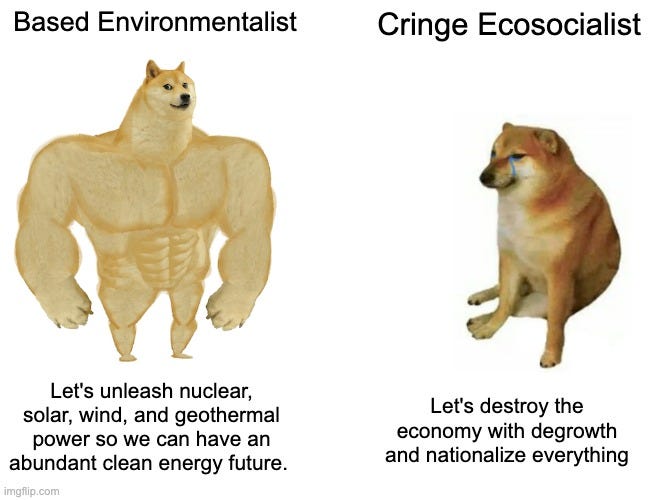
Here is a better, more liberal idea: tax emissions. It’s pretty simple. If you want polluters to pollute less, charge them for it, and they’ll find the best way to do it less. Not only is it elegantly simple and preserves individual choice to the greatest degree possible, but it also gets the government money that it can use on tax cuts, deficit reduction, or worthwhile spending priorities.
Ok, I’m tired of writing now, but I think you are getting the gist.
LIBERALS HAVE BIG AND HIGHLY MARKETABLE IDEAS. We also have the benefit of having the vast majority of economists on our side.
Now we just need to get to work MESSAGING THEM to appeal to more then just hyper nerdy wonks on the internet. Would love y’all’s help in that incredibly important political project!
We do need an abundance agenda @Micah Erfan and I broadly agree with the outline presented here.
Simple, broad programs, are better than complex ad hoc ones.
If I were designing a better society:
-Deregulate housing, occupational licensing, and undo all other counterproductive regulations.
-Abolish the capital gains, corporate incomes, and personal income tax.
-Replace income with Land Value and Value Added tax.
-Voucherize education and healthcare
As a side note, I am not totally sold on NIT or UBI, but I can make the case for generous child tax credit.
I lay out a justification for these policies at https://www.lianeon.org/p/starthere
I think the issue with example 2 is that it is an undefined concept. "Free trade" is often meant as no tariffs, but the key element oft ignored is that the good or service must be 'identical' to the good or service in the local market - predominantly around issues such as regulations, labor and environmental standards. As summarized by Rodrik (2018):
“Trade agreements could still result in freer, mutually beneficial trade, through exchange of market access. They could result in the global upgrading of regulations and standards, for labor, say, or the environment. But they could also produce purely redistributive outcomes under the guise of “freer trade.” As trade agreements become less about tariffs and nontariff barriers at the border and more about domestic rules and regulations, economists might do well to worry more about the latter possibility. They may even adopt a stance of rebuttable prejudice against these new-type trade deals—a prejudice against these deals, which should be overturned only with demonstrable evidence of their benefits.” (https://www.nominalnews.com/p/when-free-trade-isnt-free)