


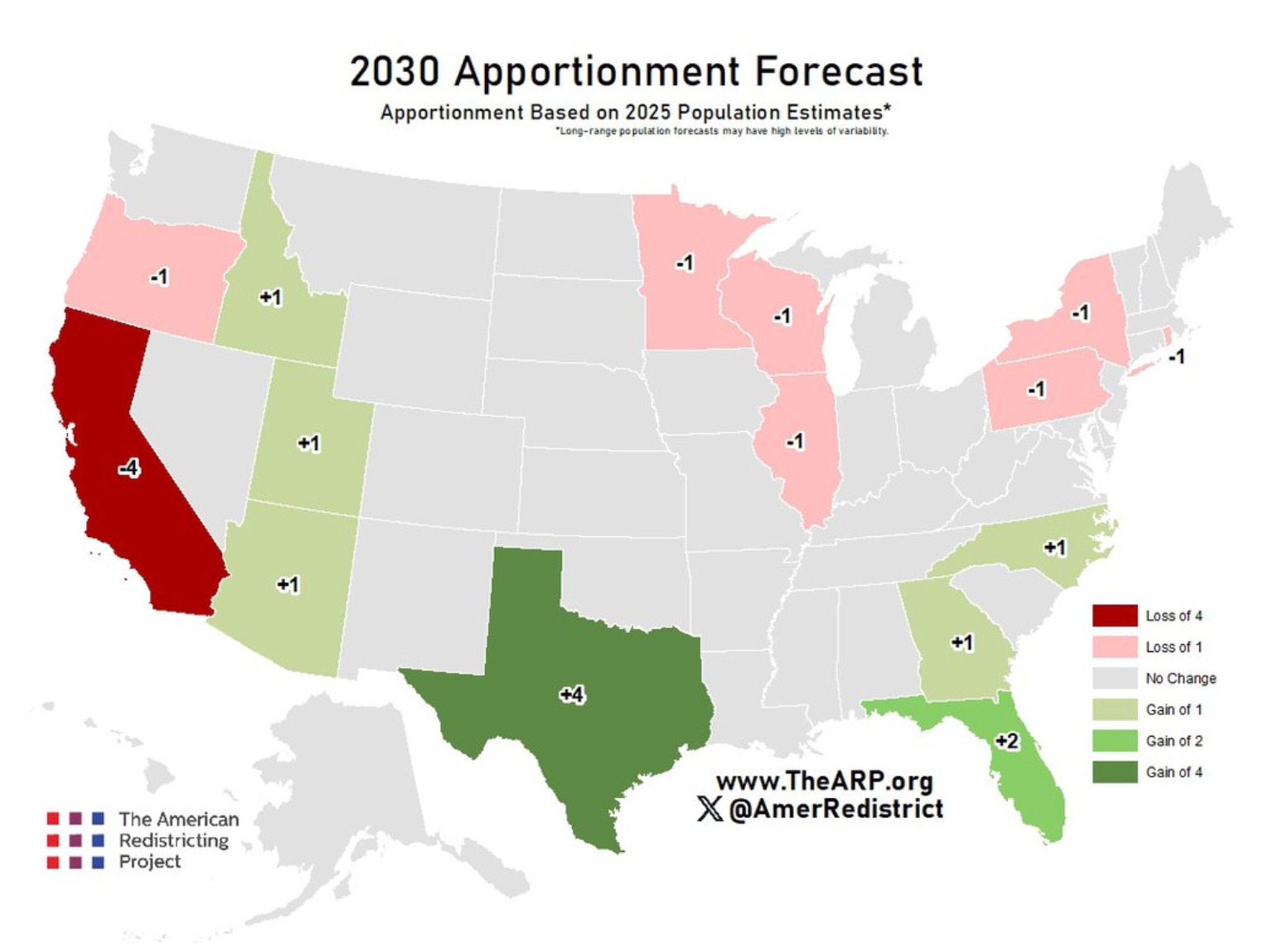
Blue states are losing people. New York, California, Illinois, and Massachusetts have all seen population decline or stagnation over the last decade, and the trend is accelerating. People are leaving for Florida, Texas, and Tennessee — not because those states have better governments, but because they have cheaper housing.
This is not just an affordability problem. It is a political crisis. Congressional reapportionment is based on population, and if blue states keep hemorrhaging residents through the 2020s, the 2030 census will hand Republicans a structural advantage in the House that Democrats may not be able to overcome for a decade. California already lost a congressional seat after the 2020 census. New York nearly lost two. If current trends continue, the next round will be worse.
The root cause is not hard to identify. Many local governments in blue states have development laws that make it damn near impossible to build anything. State Democrats have the power to fix this. Most blue states have trifectas. They have the governor’s office, the state senate, and the state house. There is no Republican blocking these reforms.
The only thing standing in the way is the political will to take on the powerful interest groups that have benefited from keeping housing scarce. This needs to be done. Here are 7 ways it can be.
1. Legalize Missing Middle Housing Statewide
Legalize medium-density multifamily housing by right in all residential zones
Legalize townhomes by right in all residential zones
Legalize accessory dwelling units by right on any residential lot, with no owner-occupancy requirement
Single-family zoning is the original sin of American housing policy. Across many blue states, it is still illegal to build a townhome, ADU (granny flat), duplex, triplex, or small apartment building on the vast majority of residential land.
Legalizing missing middle housing means allowing medium-density multifamily by right in every residential zone in the state. No special permits. No local vetoes. No discretionary review. If the lot is residential, you can build it.
This is the single most powerful thing a state can do to increase housing supply. Every unit of missing middle housing that gets built is one fewer family priced out of the neighborhood.
2. Legalize Mixed Use Development Statewide
Convert all retail and office commercial zones to mixed-use residential and commercial zones
Allow adaptive reuse of office and retail buildings for residential use by right, without requiring a full rezoning
It should be legal to build an apartment above a store anywhere in America. In most blue states, it isn’t, because retail and office commercial zones prohibit residential uses entirely.
Converting all retail and office commercial zones to mixed-use by right opens up enormous amounts of land for housing without touching a single residential neighborhood. Main streets, strip malls, and dead office parks — all of it becomes fair game for the housing that people actually need.
There are many other benefits, too. Mixed-use areas provide easy access to amenities for those who live in them. They also allow people to cut their commute by living within walking distance from where they work, thereby also reducing street traffic.
3. Lower Housing Production Costs
Reform building codes to allow single-stair construction in multifamily buildings
Legalize manufactured housing that meets HUD standards in all residential zones
It costs too much to build in America, and a significant chunk of that cost is unnecessary. Two reforms can bring it down fast.
Current building codes in most states require two stairwells in any multifamily building over a certain height. Europe has allowed single-stair construction for decades with a strong safety record. Allowing single-stair design unlocks building configurations that are cheaper to build, more efficient to use, and actually better for residents. It is one of the most impactful and least talked-about housing reforms available.
Modern manufactured homes built to HUD standards are safe, durable, and significantly cheaper to produce than site-built homes. Most residential zones still prohibit them through aesthetic requirements designed to keep out lower-income residents. Requiring all residential zones to permit HUD-standard manufactured housing puts homeownership back within reach for people who have been shut out for a generation.
4. Tear Down Permitting Barriers
Cap permitting fees at a level that reflects actual administrative costs
Cap permitting wait times with automatic approval if the government misses the deadline
Even when housing is technically legal to build, local governments can kill it through the permitting process. Fees pile up. Applications sit for months. Approvals get delayed indefinitely with no accountability.
States need to cap permitting fees at a level that reflects actual administrative costs, not a revenue stream for local government. And they need to set hard deadlines for permit approvals, with automatic approval if the government misses the deadline. If a city wants the housing, it will process the permits. If it doesn’t process the permits, the housing gets built anyway.
5. Ban Impact Fees on Housing
Ban impact fees on all new housing development statewide
Impact fees are charges that local governments impose on new housing developments to fund infrastructure. In theory, developers pay for the roads and schools their projects create demand for. In practice, impact fees have become a tool to price housing out of the market and protect wealthy homeowners from new neighbors.
In many California jurisdictions, impact fees add $50,000 to $100,000 to the cost of a single unit. That cost does not disappear. It gets passed on to renters and buyers. Blue states should ban impact fees on housing entirely and fund infrastructure through broad-based taxation instead.
6. Stop Frivolous Litigation from Blocking Housing
Reform standing requirements so only parties with direct, genuine harm can challenge housing projects in court
In most states, virtually anyone can sue to block a housing project on environmental or procedural grounds. You do not need to own property near the project. You do not need to demonstrate actual harm. You just need a lawyer and enough money to drag the process out until the developer gives up.
States should reform standing requirements so that only people with a genuine, direct stake in a project can challenge it in court. Projects that comply with state housing law should not spend years in litigation before a single unit gets built.
7. Enforce the Law
Create a state housing appeals board where developers can challenge local denials that violate state housing law, with real enforcement teeth
None of the above matters if local governments can ignore state housing law without consequence.
Blue states need a state housing appeals board with real teeth. When a local government denies a housing project that complies with state law, developers need a fast, low-cost way to challenge that denial and win. Not a years-long court battle. A state administrative process with clear timelines, binding decisions, and penalties for local governments that repeatedly violate state housing mandates.
California has spent years passing housing laws that cities quietly ignore. The lesson is clear: transparency without enforcement is just paperwork. If blue states are serious about the housing crisis, they have to be serious about making sure their own laws get followed.
The housing crisis is not a mystery. We know why housing is expensive. We built a system of laws designed to make it expensive, and the people who benefit from high home prices have fought to keep that system in place. Democrats have the power in blue states to dismantle it. The only question is whether they will.
Some Democratic Governors have taken the lead on this. Including JB Pritzker recently with his bold new BUILD agenda. We need more Governors, and just as importantly, state legislatures to follow suit.

Our democracy hangs in the balance.
Much of the population decline in the Midwest has been due to the hollowing out of rural areas. It's a regional thing – not limited to Illinois, Wisconsin, and Minnesota. Incentives for small to medium sized businesses in such areas would provide a boost. At the same time, a trickle of climate refugees from parts of the US prone to hurricanes, wildfires, and excessive heat have begun to re-colonize the Upper Midwest. Real estate in Duluth is a good long term investment. Eau Claire is a good pick as well.
Houston, TX could do a lot better with density if it were not a shrine to the automobile with its surfeit of roads and parking lots.
https://www.youtube.com/watch?v=uxykI30fS54
Nevertheless, affordable housing is never a bad idea anywhere. And it should be paired with good public transit and sufficient space for pedestrians and cyclists. We don't need a rerun of the 1950s and 1960s in terms of urban planning.
I completely agree Micah. Basically families are continually split up as housing for the kids and grandkids are too expensive to keep the family unit together. Families that would have lived in close approximation, cannot and it’s often the elderly parents that are left alone. The political aspect is important yes, but the capitalistic separation of family units puts another whole twist on your story. This just does not happen in other sophisticated countries like Italy, Greece and Spain to mention just a couple. The family unit is the most important thing to them. Watch a few “Yes Theory” videos and you will see that around the world, families stay together. Those simp,e values are slipping away here in America. And how interesting that this is a nation of immigrants who honor the practice of keeping families close.
Thank you for your article and for igniting my spark.